

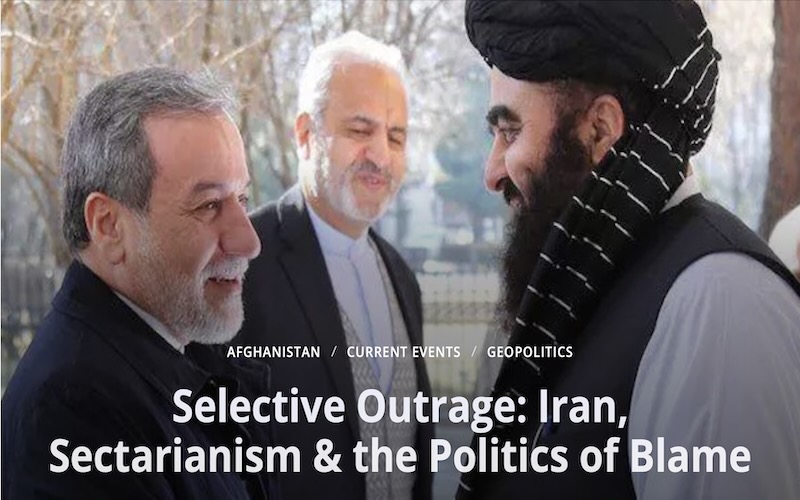
In the context of the current tensions between Iran and the U.S.-Israel axis, a number of ideologically driven actors, ranging from Wahhabis to neo-Ba’athists, have sought to adopt what appears to be a “centrist” posture.
Their stance can be summed up via the claim that “the defeat of both sides would be preferable.” This framing, however, is rarely neutral. It is typically accompanied by a selective invocation of Iran’s foreign policy and actions in Iraq, Afghanistan, and Syria, presented in a way that reduces complex geopolitical dynamics to a purely sectarian narrative.
Here at Muslim Skeptic, we have consistently maintained that oppression against Muslims must be condemned, irrespective of the perpetrator. Thus, just a few years ago, we had produced a critique of Qassem Soleimani’s foreign policy decision.
At the same time, a more analytical perspective requires recognizing the structural nature of the modern state. The post-Peace of the Westphalian international system is built upon the notion of the state being the primary political unit, endowed with what Max Weber described as the “monopoly of the legitimate use of force.” In Muslim-majority societies, this would thus imply that the immediate agent of violence against Muslims will often, by definition, be a Muslim state.
This raises an important question: to what extent can responsibility be attributed to the state as a whole, rather than just its decision-making elites?
Historical examples complicate any simplistic attribution of collective guilt. In Afghanistan, the communist government’s alignment with the Soviet Union facilitated the Soviet invasion of 1979–1989, a conflict that resulted in approximately 1–2 million deaths, several million injured, and around 5–6 million refugees, representing a significant proportion of the country’s population at the time (13 million). Similarly, in Pakistan, the launch of Operation Searchlight in 1971, intended to suppress Bengali separatism and target the Hindu elements in particular, led to mass violence, with estimated number of deaths ranging into the hundreds of thousands, as well as large-scale displacement.
Yet it would be analytically imprecise to treat Afghanistan or Pakistan (as enduring political communities) as indefinitely and collectively responsible for the actions of specific policies. A possible counter-argument could be that these cases concern domestic policy, while Iran’s actions are often framed as foreign intervention. However, even this distinction does not resolve the issue of selective moral judgment. Comparable cases of external policy producing large-scale humanitarian consequences can also be found elsewhere. For instance, the Saudi-led intervention and blockade in Yemen since 2015, which has contributed to one of the world’s worst humanitarian crises, involving hundreds of thousands of deaths (direct and indirect) and widespread famine conditions.
The broader point is not to absolve any state of responsibility. It is to challenge the inconsistency with which such responsibility is assigned. Reducing Iran’s regional policy to a uniquely sectarian or expansionist project, while overlooking similar patterns of behavior by other states, reflects less an objective analysis than it does a politically conditioned narrative.
Against this contextual backdrop, let us now take a look at Iran’s controversial role in Iraq, Afghanistan, and Syria.
Table of Contents
Iran in Iraq
A commonly invoked argument holds that Iran “collaborated with the United States” in the overthrow of Saddam Hussein in 2003, implying a form of strategic alignment. Such a claim, however, overlooks the historical context that shaped Iran’s perception of the Iraqi regime. For Iran, Saddam Hussein was not simply a regional adversary. In their eyes, he was the architect of an existential conflict: the Iran-Iraq War.
This eight-year war resulted in hundreds of thousands of deaths on both sides (estimates often range from 500,000 to over 1 million casualties, including military and civilian), as well as millions injured and displaced. The conflict was marked by extensive use of chemical weapons by Iraq, including against Iranian troops and civilians – for instance, during attacks on cities such as Sardasht in 1987. Iraq’s use of such weapons was widely documented, yet met with limited effective international response.
Equally important is the extent to which Iraq was supported during the war. Saddam’s regime received financial backing from Gulf monarchies, including Saudi Arabia and Kuwait, amounting to tens of billions of dollars. It also benefited from military, intelligence, and logistical support from major powers, including the United States and several European states, as well as the Soviet Union at different stages. Western companies were later implicated in providing materials that could be used in Iraq’s chemical weapons program. This broad-based support reflected a strategic consensus aimed at containing post-revolutionary Iran.
From an Iranian perspective, therefore, the removal of Saddam Hussein in 2003 did not represent opportunistic alignment with the United States. Rather, it represented the elimination of a long-standing security threat. Thus, the broader analytical point is that Iran’s posture toward Iraq after 2003 cannot be understood in isolation from the preceding decade of war and external intervention. To frame Iran’s actions solely as expansionist or sectarian is to neglect the historical experience that continues to shape its threat perceptions and regional strategy.
A further point often omitted in neo-Ba’athist or polemical narratives is Iran’s role in supporting elements of the Iraqi insurgency against U.S. forces after 2003. While this is frequently invoked as evidence of destabilization, it can also be interpreted within a broader strategic logic. Following the U.S. invasion, Iran sought to accelerate the withdrawal of American forces and prevent the emergence of a hostile, U.S.-aligned Iraq on its western border.
Empirically, Iran’s involvement operated primarily through indirect means, notably via support to Shi’ah militias often referred to as the “Special Groups.” They included organizations such as Asa’ib Ahl al-Haq and Kata’ib Hezbollah. These groups were supplied, trained, and in some cases directed by elements of the Islamic Revolutionary Guard Corps (IRGC), particularly the Quds Force.
One of the most significant tactical contributions attributed to Iranian support was the proliferation of Explosively Formed Penetrators (EFPs), a type of roadside bomb capable of penetrating armored vehicles. U.S. intelligence officials described these devices as being responsible for a substantial portion of American casualties in Iraq. According to U.S. military reporting, such weapons accounted for around 30% of U.S. fatalities in certain areas outside Anbar province, as was reported in a 2007 article titled “Iran and Syria’s proxy war in Iraq“:
U.S. intelligence traces an especially lethal form of roadside bomb, known as an explosively formed penetrator, directly back to Iran. These sophisticated devices utilize precisely machined copper discs activated by a radio link and triggered by a passive infrared sensor. The semi-molten copper slug produced when the device is detonated can penetrate the armor of many Army and Marine vehicles, wreaking havoc on those inside. Iraq’s industrial base lacks the technical capability to manufacture these precision anti-armor weapons. Moreover, they are identical, right down to the radio frequencies used to activate them, to anti-tank weapons used against Israeli forces last summer by the Iranian-armed Hezbollah guerrillas in Lebanon.
U.S. commanders report that these bombs inflicted 30 percent of all American military casualties (excluding Anbar province, where the weapons have not been encountered) during the last three months of 2006.
In 2007, Director of National Intelligence Michael McConnell stated there was “overwhelming evidence” that Iran was providing material support to Iraqi and Afghan insurgents, particularly through advanced weaponry.
Again in 2007, historian Kimberly Kagan wrote the following in “The Iran Dossier“:
Iran has consistently supplied weapons, its own advisors, and Lebanese Hezbollah advisors to multiple resistance groups in Iraq, both Sunni and Shia, and has supported these groups as they have targeted Sunni Arabs, Coalition forces, Iraqi Security Forces, and the Iraqi Government itself. Their infl uence runs from Kurdistan to Basrah, and Coalition sources report that by August 2007, Iranian-backed insurgents accounted for roughly half the attacks on Coalition forces, a dramatic change from previous periods that had seen the overwhelming majority of attacks coming from the Sunni Arab insurgency and al Qaeda.
In 2015, Senator Ted Cruz, during a senate hearing on a nuclear deal with Iran, stated the following:
Secretary Carter, I understand that the Joint Personnel Recovery Agency has a classified list of roughly 500 American soldiers who were murdered by Iranian IEDs [improvised explosive devices]. I would ask, Secretary Carter, so that we can do what Secretary Kerry suggested, that the Defense Department release that list to every member of this committee, declassify that list and release it directly to the service members’ families who were murdered by General Soleimani.
There are numerous similar statements from senior U.S. officials that can be found.
So yes, Iran did, at least initially, converge with the United States in the overthrow of Saddam Hussein. But to present this exclusively as some sort of ideological alignment is absurd. For Iran, Saddam was not a neutral actor. He was the very figure who had launched the Iran-Iraq War, eight years of devastation, chemical attacks, and mass casualties, carried out with the backing of much of the international system. The idea that Iran would take advantage of an opportunity to eliminate such a nemesis is the most elementary form of strategic rationality.
And what followed should end the discussion: Once Saddam was removed, Iran did not “align” with Washington. It moved to undermine it. Iranian networks, through militias and indirect channels, actively targeted U.S. forces in Iraq, raising the cost of occupation and accelerating the pressure for withdrawal.
More importantly, the sectarian reading collapses under minimal scrutiny. If Iran were driven only by anti-Sunni animus, its strategy would be rigid. Yet even within the Islamic Revolutionary Guard Corps, this was not the case. During a 2021 interview, the late General Amir Ali Hajizadeh (killed during the 12 Day War), commander of the IRGC Aerospace Force, responsible for Iran’s missile program and a central figure in its strategic apparatus, has pointed to internal debates in which the guiding question was not sectarian loyalty but, rather, how best to weaken Western power within the region. At certain moments, the calculus was such that even outcomes involving helping Saddam Hussein could be tolerated if they contributed to achieving that objective, though Ayatollah Khamenei (using arguments much like the Madkhalis of today) had dissuaded them:
During the liberation of Kuwait in the first Gulf War, many figures inside the country argued that Saddam Hussein had assumed the role of Khalid ibn al-Walid and that we ought to align with him to fight against the US. Even some officials in positions of authority at the time advocated this view. The only person who recognized this as a trap and understood that both sides of this conflict represented misguided factions — that is, the West, including the US and Europe, on one side, and Saddam on the other — was the Leader. He did not allow the country and our Armed Forces to be caught in this trap.
Sectarianism in post-2003 Iraq was undeniably real, but to attribute it exclusively to Iran is to ignore the structure that preceded it. For decades, Saddam Hussein had systematically marginalized the religiously heterodox Shi’ah majority. The regime engaged in repression, surveillance, and targeted violence against Shi’ah political and religious networks. One of the most emblematic cases was the execution in 1980 of Muhammad Baqir al-Sadr, a leading intellectual and religious authority, along with his sister, following years of persecution.
These policies entrenched a deep reservoir of grievance within Iraqi Shi’ah society. As a result, the fall of Saddam’s regime in 2003 did not create sectarian tension ex nihilo. Instead, it unleashed a pre-existing dynamic shaped by decades of rule and exclusion. Even in the absence of Iranian involvement, it is highly likely that the sudden reversal of power, from a Sunni-dominated regime to a Shi’ah-majority political order, would have produced forms of reactive or “revenge” sectarianism, a pattern observed in other post-authoritarian contexts.
Still, Ayatollah Khamenei had directly blamed sectarian violence as a foreign conspiracy in 2006, and this is not even taking into account the additional factor of al-Zarqawi’s role in actively manufacturingsectarian war. Zarqawi did not simply operate within an existing sectarian landscape. He sought to radicalize it deliberately. His strategy was to force Iraq into a cycle of sectarian violence that would make coexistence impossible. Zarqawi’s network thus carried out mass-casualty attacks specifically targeting Shi’ah civilians and religious sites, most notably the 2006 bombing of the al-Askari Mosque, one of the holiest Shi’ah shrines.
The attack triggered a wave of reprisals and is widely seen as a turning point in Iraq’s descent into full-scale sectarian civil war. The consequence was predictable: Shi’ah militias, many of which had previously been politically oriented or locally defensive, became increasingly radicalized and militarized in response to what they perceived as an existential threat. In this sense, sectarian escalation in Iraq cannot be understood solely as the product of Iranian influence or Shi’ah mobilization. It was also the result of a deliberate strategy by Wahhabi actors to provoke and harden sectarian identities.
RELATED: The Inevitable Failure of Political Shi’ism: The Secularization of Iran
Iran in Afghanistan
Another recurring point of contention is Iran’s role in assisting the United States in the overthrow of the Taliban in 2001. Yet, here too, such claims are often presented without context. During the rule of Mullah Omar (1996–2001), relations between Iran and the Taliban were already deeply strained, and this was for reasons that went well beyond simple geopolitics.
From the Taliban’s perspective, Iran had been actively supporting their enemies during the Afghan civil war, most notably factions of the Northern Alliance, including Tajik and Hazara groups opposed to Taliban rule. Iran, for its part, accused the Taliban of pursuing a rigid and exclusionary order, often interpreted in Tehran as sectarian hostility toward Shi’ah communities, particularly the Hazara population. These tensions culminated in one of the most serious crises between the two: the killing of 11 Iranian diplomats and a journalist in 1998 in Mazar-i-Sharif after Taliban forces captured the city.
The incident brought Iran and the Taliban to the brink of open war. Iran mobilized tens of thousands of troops along the Afghan border, and direct military confrontation was widely thought to be imminent. Although war was ultimately avoided, the episode left a lasting imprint on Iranian threat perceptions.
In this light, Iran’s limited cooperation with the United States in 2001 could be argued to be less an ideological alignment and more a convergence of interests against a common adversary. The Taliban were not a neutral force in Iranian strategic thinking. They were viewed as being associated with direct violence against Iranian personnel, hostility toward Shi’ah populations, and alignment with anti-Iranian regional dynamics.
However, the dynamics changed significantly after the fall of the first Taliban regime, when the movement shifted into insurgency. From that point onward, Iran’s approach became far more pragmatic and adaptive. As highlighted in an investigation called No love lost: The six men who forged Iran and the Taliban’s unlikely bond, a deep look into Iran-Taliban relations, the Islamic Revolutionary Guard Corps (IRGC) gradually developed contacts with senior Taliban figures, who moved between Iran and Afghanistan and maintained channels of communication with Tehran. Among these Taliban leaders was Ibrahim Sadr, a “faithful friend of Iran’s Revlutionary Guards” (as they put it). He had been head of the Taliban’s military commission, effectively overseeing large parts of the insurgency’s operations across key provinces. He also later became deputy interior minister after the Taliban’s return to power in 2021.
Iranian involvement was not marginal, and this is acknowledged even in Western academic literature. As Antonio Giustozzi – one of the most prominent specialists on the Afghan war, a researcher affiliated with institutions such as the Royal United Services Institute (RUSI), and author of the widely cited The Taliban at War: 2001–2018 – notes, Iranian support to the Taliban became increasingly significant over time, to the point of rivaling Pakistan’s traditional role.
Giustozzi explicitly highlights that the Islamic Revolutionary Guard Corps (IRGC) was not merely supplying resources but that they were contributing to the professionalization of the insurgency:
Another reason to appreciate the Iranian help was that the Pasdaran were more willing than the Pakistanis to transfer skills and training to the Taliban, aiming to engineer an organisational and technological upgrade of the insurgency.
This was particularly visible in the development of insurgent tactics:
IED making skills might have been refined locally but were not originally developed by individual Taliban groups… ISAF officers also believe that the Taliban could not have developed the IED techniques alone… Iranian and Pakistani help also occurred.
This was acknowledged:
A Pakistan ISI adviser believed that the Iranian Pasdaran transferred significant knowledge to the Taliban, which made the Mashhad Taliban the best trained of all.
Beyond training, the scale of material support grew steadily. While early Taliban logistics depended almost entirely on Pakistan, Iran became an increasingly important supplier:
From 2005 Iran also began sending supplies… By 2014 the Taliban in north-western Afghanistan and Ghor received 20–30 per cent of their supplies from Iran… In western Afghanistan, Iran accounted for up to 80 per cent of supplies…
Financial assistance followed a similar trajectory:
2006: $30 million
2007: $30 million
2008: $40 million
2009: $40 million
2010: $60 million
2011: $80 million
2012: $160 million
2013: $190 million
Thus, the relationship evolved in a way that is often overlooked: from outright hostility, Iran moved, even if out of sheer pragmatism, to become, in certain contexts (especially the “Mashhad office” and the “career” of Mullah Akhtar Mansour, the second Supreme Leader following Mullah ‘Umar), a competitor to Pakistan itself in influence and support for the Taliban.
Iran in Syria
The most contentious point is arguably Iran’s intervention in Syria. Unlike Iraq or Afghanistan, where Iranian policy can be framed as reactive, Syria is often presented as the clearest case of deliberate expansion. Yet, even here, the picture is more complex than the usual sectarian narrative suggests.
From Tehran’s perspective, the survival of Bashar al-Assad’s government was not primarily about sectarian solidarity. It was about preserving a strategic ally and maintaining regional balance. Syria had long been a key component of Iran’s regional network, providing a corridor to Hezbollah and serving as a frontline state against Israeli influence. As Ali Akbar Velayati (a former Foreign Minister and senior advisor to Ayatollah Khamenei) put it, Syria was “the golden ring” in the chain of resistance against Israel,” underscoring its geopolitical (not just purely sectarian) value.
This logic was reinforced by the composition of the opposition itself, which included powerful Wahabbi factions such as Islamic State and Jabhat al-Nusra. From Iran’s standpoint, the collapse of the Syrian state risked producing a scenario similar to Iraq after 2003 but on a far larger scale, with direct spillover effects across the region.
None of this negates the violence or the human cost of the intervention, which we have detailed numerous times on Muslim Skeptic. But it does complicate the claim that Iran’s role in Syria was driven only by sectarian ambition. Iran’s actions can be understood as being part of a broader effort to preserve a strategic axis, prevent hostile encirclement, and avoid state collapse in a neighboring region. In other words, as a form of geopolitical calculation rather than purely ideological crusade. And yes, it’s possible that there may also have been an element of sectarianism too.
Within this context, the argument that Iran has pursued nothing more than a systematic policy of “Shi’i demographic replacement” in Syria has become one of the most widely circulated claims in polemical discourse. Yet, on closer inspection, it tends to rely more on extrapolation rather than demonstrable large-scale evidence:
- First, there’s the scale problem. Syria’s population before the war was over 20 million, overwhelmingly Sunni. Even at the height of the conflict, estimates of foreign Shi’ah fighters and families, whether Iraqi, Afghan (e.g. Liwa Fatemiyoun), or others, numbered in the tens of thousands at most. This is not a demographic base capable of altering the sectarian composition of an entire country. What is observable instead are localized, strategic redeployments, often linked to specific military fronts or security corridors.
- Second, much of what is described as “demographic engineering” overlaps with wartime displacement dynamics seen in virtually all civil wars. The Syrian conflict produced over 6 million internally displaced persons and millions of refugees, a scale of movement driven by combat, sieges, and economic collapse, not exclusively by sectarian design. To attribute these shifts uniquely to Iranian policy is to isolate one actor in what is in reality a multi-sided war involving state and non-state actors, each contributing to population movements.
- Third, even critics who document cases of property transfers or resettlement tend to frame them as limited and opportunistic, rather than as a coherent, centrally executed plan of sectarian transformation. Reports often point to specific neighborhoods, particularly around Damascus or along strategic supply routes, where pro-government populations were consolidated. But this is more consistent with a security logic (holding territory, securing corridors) than it is with a nationwide project of demographic reengineering.
- Finally, the argument itself often rests on an assumption that Iranian policy is primarily sectarian. Yet, as seen in Iraq and Afghanistan, Iran has repeatedly demonstrated a willingness to work with non-Shi’ah actors, including Sunni groups, when it serves its strategic interests. This does not negate sectarian elements within the conflict, but it does undermine the idea of a singular, ideologically driven project of some “neo-Safavid” Shi’ah expansion. On top of all this, it must be noted that Iran adheres largely to the heterodox Twelver/Imamiyyah Shi’ah beliefs, and they consider the ‘Alawi Shi’ah of Syria to be outright disbelievers.
Also, one cannot help but notice the selective outrage. If Iran’s role in Syria is constantly invoked, why is the role of Russia so often treated as secondary or ignored altogether? This is despite the fact that Russia’s intervention was far more direct, more large-scale, and more destructive.
Russian involvement, beginning in 2015, was not limited to advisory roles or indirect networks. It consisted of massive airpower deployment, sustained bombing campaigns, and direct military intervention in support of Bashar al-Assad. According to multiple reports, Russian airstrikes killed over 7,700 civilians by 2018 alone, with human rights organizations accusing Moscow of targeting hospitals, schools, and civilian infrastructure, and employing indiscriminate weapons such as cluster munitions and thermobaric bombs. In other words, if one is to speak in terms of scale and method, Russia’s intervention was not merely influential. It was decisive and overwhelmingly kinetic, shaping the course of the war through sheer firepower.
And yet, the same voices that reduce Iran’s role to sectarian engineering rarely apply the same logic here. Even more striking is the recent evolution of Syrian politics itself. Ahmed al-Sharaa, Syria’s incumbent President, formerly known as Abu Mohammed al-Jolani, a figure who once led insurgent forces against both Assad and Russian-backed operations, has since engaged directly with Moscow. He has met with Vladimir Putin and acknowledged Russia’s role in Syria, describing it as having a “historic” importance for the country’s stability.
This alone should complicate any overly simplistic narrative. A figure who was once the target of Russian airstrikes is now negotiating with Moscow, seeking cooperation and even allowing continued Russian presence. If pragmatism is acknowledged in this case, why is it denied in Iran’s? If engagement with Russia after years of conflict is understood as strategic recalibration, why is Iran’s engagement with various actors reduced to just sectarian ambition?
RELATED: A Brief History of the War on Syria
Iran in Bosnia
And beyond all of this, there is a deeper question that is almost never asked: Why is Iran’s role only discussed when it is negative? Why is there such reluctance to acknowledge other cases where Iran had acted in ways that do not neatly fit the sectarian narrative?
Take the example of Bosnia. During the Bosnian War, Iran, despite being a Shi’ah-majority state, was among the first and most significant supporters of the Bosnian Muslims, who are overwhelmingly Sunni. It provided arms, training, intelligence support, and logistical assistance at a time when the Bosnian government was, by many accounts, on the verge of collapse. In fact, Iran shipped thousands of tons of weapons, sent advisers from the Islamic Revolutionary Guard Corps, and helped organize and train Bosnian forces. Western officials themselves acknowledged that this external support helped the Bosnians redress the military imbalance and survive long enough to reach the Dayton Accords.
By the end of the war, surveys suggested that around 86% of Bosnian Muslims held a favorable view of Iran, reflecting the perception that Tehran had stepped in when others hesitated.
This alone should be enough to challenge the simplistic claim that Iran’s foreign policy is driven by sectarian hostility toward Sunnis. Here is a clear case where a Shi’ah state materially supported a Sunni population under siege, on a scale that went well beyond mere rhetoric alone. This seems to indicate that some people may be more anti-Iran than they are pro-Islam/Sunnis.
Iran, like any other Muslim-majority state, can and should be subject to criticism. Absolutely. But criticism requires proportion and coherence. To reduce its policies to a single explanatory variable, such as sectarianism, is not analysis. A more serious approach demands that we retain the ability to grasp the full complexity of state behavior, rather than forcefully trying to collapse it into essentialist categories.