

The beach town of Saidia, Morocco, is made up of two half-cities. In one there is the great roller coaster with its steep humps, the carousel with its chain spokes, the Ferris wheel of spinning cages, the ATV-riders and motorcyclists emitting ear-splitting auditory mayhem, the summer exhibits and fairs and displays, the Marina district with its pampered yacht-owning golfers, the line of dubiously legal beachside cafes serving overpriced food and drink, and beyond them the beach itself: a mass of unevenly-clothed human flesh partially shaded by parasols, jam-packed so tightly that scarcely a grain of sand can be seen, pressed up against the edge of luminous turquoise infinity: the sea.
The other half-city—the banks, hospital, factories, schools, government buildings, hardware stores, convenience stores, and the rest—might as well pack up and migrate elsewhere during the off-season. Sometimes it does seem that the authorities have wandered off to more governable pastures: goats and sheep wander freely gobbling up people’s gardens, litterbugs shamelessly defile sand and pavement, motorists ignore red lights, mail delivery service is nonexistent, and packs of mostly-friendly wild dogs howl at moon and stars, and failing that, the clouds and whatever lies behind them.
Meanwhile the roller coaster stands silent, its silhouette a mute reminder of better things to come.
-Kevin Barrett, Saidia, Morocco
From Italo Calvino’s Invisible Cities:
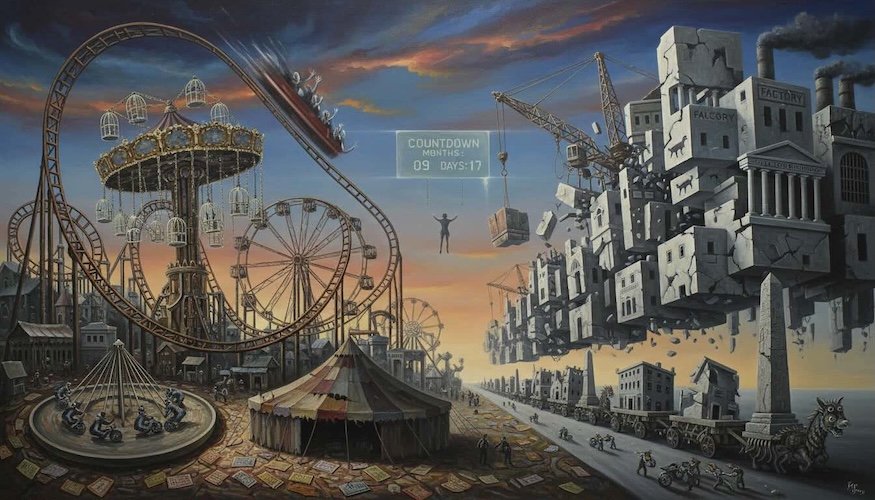
The city of Sophronia is made up of two half-cities. In one there is the great roller coaster with its steep humps, the carousel with its chain spokes, the Ferris wheel of spinning cages, the death ride with crouching motorcyclists, the big top with the clump of trapezes hanging in the middle. The other half-city is of stone and marble and cement, with the bank, the factories, the palaces, the slaughterhouse, the school, and all the rest. One of the half-cities is permanent, the other is temporary, and when the period of its sojourn is over, they uproot it, dismantle it, and take it off, transplanting it to the vacant lots of another half-city.
And so every year the day comes when the workmen remove the marble pediments, lower the stone walls, the cement pylons, take down the Ministry, the monument, the docks, the petroleum refinery, the hospital, load them on trailers, to follow from stand to stand their annual itinerary. Here remains the half-Sophronia of the shooting galleries and the carousels, the shout suspended from the cart of the headlong roller coaster, and it begins to count the months, the days it must wait before the caravan returns and a complete life can begin again.
—
La ville de Sophronia est composée de deux demi-villes. Dans l’une se trouvent les grandes montagnes russes aux bosses abruptes, le carrousel à chaînes, la grande roue aux nacelles tournantes, le manège mortel avec ses motocyclistes accroupis, et le chapiteau avec son amas de trapèzes suspendus au centre. L’autre demi-ville est de pierre, de marbre et de ciment, avec la banque, les usines, les palais, l’abattoir, l’école, et tout le reste. L’une des demi-villes est permanente, l’autre temporaire. Lorsque sa période de service est terminée, on la déracine, on la démantèle et on la transplante sur les terrains vagues d’une autre demi-ville.
Ainsi, chaque année vient le jour où les ouvriers retirent les frontons de marbre, abaissent les murs de pierre, les pylônes de ciment, démontent le ministère, le monument, les docks, la raffinerie de pétrole, l’hôpital, les chargent sur des remorques et suivent leur itinéraire annuel, d’emplacement en emplacement. Il reste ici la demi-Sophronia des stands de tir et des manèges, le cri suspendu au wagon des montagnes russes vertigineuses, et elle commence à compter les mois, les jours qu’elle doit attendre avant le retour de la caravane et le retour d’une vie normale.
—
مدينة سوفرونيا تتألف من نصفَي مدينة. في أحدهما توجد الأفعوانية الضخمة بمنحدراتها الحادة، والدوامة بسلاسلها، وعجلة فيريس بأقفاصها الدوارة، ولعبة الموت بدراجيها النارية المنحنين، وخيمة السيرك الكبيرة بمجموعتها من الأرجوحات المعلقة في المنتصف. أما النصف الآخر من المدينة فهو مبني من الحجر والرخام والإسمنت، ويضم البنك والمصانع والقصور والمسلخ والمدرسة، وكل ما تبقى. أحد النصفين دائم، والآخر مؤقت، وعندما تنتهي مدة وجوده، يُقتلع من جذوره، ويُفكك، ويُنقل إلى الأراضي الشاغرة في النصف الآخر من المدينة.
وهكذا يأتي كل عام اليوم الذي يُزيل فيه العمال الواجهات الرخامية، ويُخفضون الجدران الحجرية، والأعمدة الإسمنتية، ويُفككون الوزارة، والنصب التذكاري، والأحواض، ومصفاة البترول، والمستشفى، ويُحملونها على مقطورات، ليتبعوها من مكان إلى آخر في مسارهم السنوي. هنا تبقى نصف سوفرونيا صالات الرماية والدوارات، والصيحة المعلقة من عربة الأفعوانية المتهورة، وتبدأ في عد الأشهر والأيام التي يجب أن تنتظرها قبل عودة القافلة وبدء حياة كاملة من جديد.