

Many Muslims find Claire Khaw’s Secular Koranism congenial but unnecessary. After all, the Islamic way of life, complete with rules to live by a.k.a. legal principles and even some clear injunctions, is already based on the Qur’an, so why secularize it?
But Khaw isn’t telling Muslims they ought to live by Qur’anic principles. We already know that. Her primary audience is non-Muslims. And by explaining to non-Muslims the advantages of living by Qur’anic principles, in closely-reasoned secular language, she is doing them, and the world, a service. Even those who resist her message have to admit that she’s starting a thought-provoking conversation!
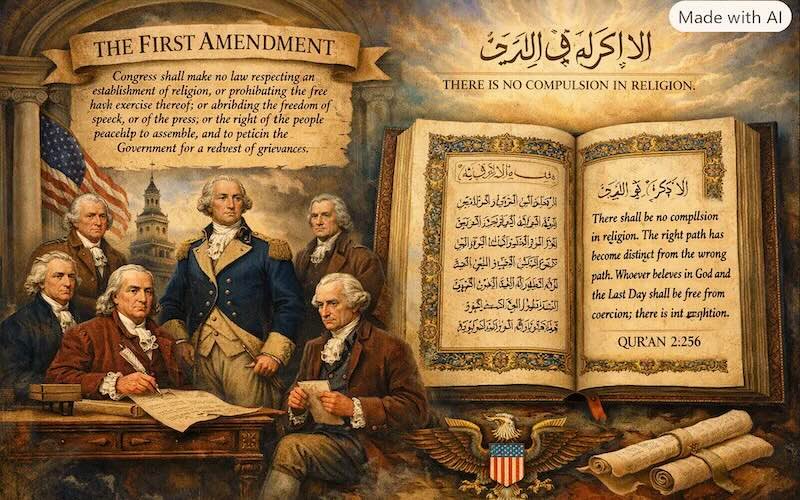
This piece conveys the visionary side of Khaw’s project, and jibes with American Muslims’ intuitions that the American founders, as well as other Enlightenment Unitarians, were inspired by the Qur’an. -ABaB
The Islamic roots of the American Republic
By CLAIRE KHAW – SECULAR KORANIST
In the humid summer of 1774, as the first Continental Congress gathered in Philadelphia, a quiet circle of men met by candlelight in a back room of the City Tavern. Thomas Jefferson, Benjamin Franklin, John Adams, and a few trusted others sat around a scarred oak table. Outside, the streets still echoed with the ordinary concerns of merchants and farmers. Inside, they spoke of something far older and more dangerous.
“The right we seek is not merely independence from a king,” Jefferson said, his voice low. “It is the right of every European mind—every soul that crossed the ocean—to stand before the Creator as a free man. No Trinity forced upon him. No creed that multiplies the One into three. Only ethical monotheism: one God, and a moral law written on the heart.”
Franklin nodded, spectacles glinting. “Deism, Unitarianism, the pure faith of reason. The colonies already lean that way in private. But if we declare it openly, the pulpits will cry heresy. The people still love their hymns and their mysteries.”
Adams frowned. “We cannot tell them the full truth. Not yet. The path of pure monotheism, once the Trinity is set aside, leads inevitably toward the same austere oneness that the Prophet of Arabia proclaimed. One God. No partners. Submission to the moral order. If the common folk glimpse that horizon too soon, they will call us Mohammedans and burn the Declaration before it is signed.”
So they chose silence on that point. The revolution they prepared would speak of liberty, of natural rights, of the pursuit of happiness. It would never mention the distant mosque or the crescent. They would frame every argument in the language of Locke and the ancient Hebrews, of Cicero and the purest Christians who had rejected Athanasius. The people would fight for freedom of conscience. Only later, if ever, would they see where that freedom pointed.
The war came. Muskets cracked at Lexington. Washington’s army froze at Valley Forge. Through it all the inner circle kept their counsel. In pamphlets and speeches they praised “the God of Nature” and “the Creator.” They struck the Trinity from state constitutions where they could. Jefferson’s Statute for Religious Freedom in Virginia opened the door wide: no man would be compelled to support any worship against his will. Unitarian congregations began to form in New England. Deists debated in coffeehouses. The people rejoiced in their new liberty and never asked where the road continued beyond the ridge.
Years later, in the quiet of Monticello, Jefferson walked the lawn with a young visitor who had begun to suspect the pattern. “Sir,” the youth said, “the pure monotheism you champion—does it not resemble the faith that conquered the East?”
Jefferson smiled the thin smile of a man who had carried a secret across a revolution. “It resembles the truth,” he answered. “Whether that truth first spoke in the desert of Arabia or in the mind of a free European is of no consequence. We hid the resemblance only long enough for the people to claim the right. Now the right is theirs. What they do with it is between them and the One God.”
The visitor left unsettled. Across the new republic, church bells still rang on Sundays, and most citizens still recited the old creeds. Yet in the libraries and the private studies, men and women read the Gospels without the Trinity, the Torah without the later commentaries, and, more and more, the Qur’an itself—not as foreign scripture, but as another testimony to the same ethical monotheism their Founders had quietly secured for them.
The revolution had succeeded. The people had won the right to stand alone before the One. And the path they had been set upon, though never named in the public papers, stretched eastward under an open sky.