

Islam in the West: Kufr and the Politics of Burial
FARAH EL-SHARIF
JUL 8
“The earth will then tell its news” — Qur’an 99:4
“And when the girl who was buried alive is asked, for what sin she was killed?” Qur’an 81:8-9
“Islam is neither religion nor materialism; it is a way of life” — Alija Izetbegović
“They tried to bury us, they didn’t know we were seeds.”
It was my first time visiting al-Andalus this past June as an instructor for the Critical Muslim Studies Summer School. In these present times of genocidal nakba, it did not escape the attention of any of the attendees studying Islam and anti-colonialism that we were convening at the site of one of the earliest anti-Muslim nakbas.
After all, Muslim Spain was ground zero for the emergence of the Western world order and the consequent displacement of the Muslim world system. The Fall of Granada in 1492 is marked as the date that not only marked the end of Muslim political rule in Europe, but also as the era that triggered the colonization of the Americas by Columbus, thus beginning the 533 year old story of the Euro-centric world order, which we are currently still inhabiting.
In the decades that followed the cessation of the more intellectually porous, non-homogenizing Nasrid rule, Muslims who set roots there for over 7 centuries were violently forced to reckon with a new, supremacist, repressive reality: to convert to Catholicism or leave Iberia. Arabic books were burned in many places, speaking Arabic was banned, mosques and zawiyas were destroyed, and eventually, the Expulsion of the Moriscos forcibly eradicated hundreds of thousands of descendants of Iberian Muslims.
It was barbaric, it was vicious. It was—and remains—an act of systemic burial.
We learned of unmarked graveyards of believers who held on to their faith like hot embers. Traces of sacred calligraphy the conquistadors forgot to erase. Hidden doorways to unseen portals and entombed prayer niches. Manuscripts hidden in cracks and the whispers of stubborn, transcendent beauty of a civilization that once centered the sacred as its guiding ethos.
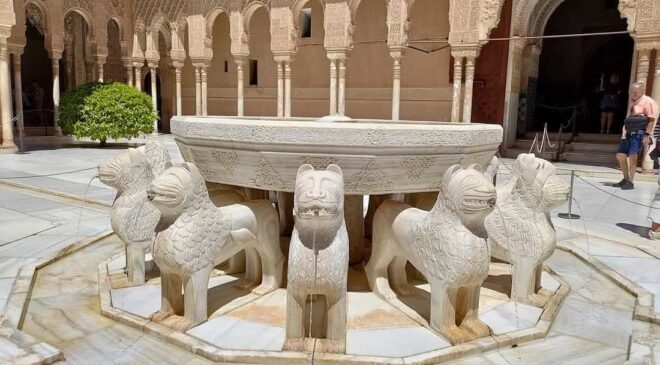
Despite this, Muslim presence still resists this active inhumation. Take the enchanting Lion Clock in the court of Alhambra palace, which reportedly malfunctioned, but no Spanish craftsman could understand its complex mechanics, so that they had to fly in Muslim artisans from Fes to create a replica as the original could never function as its once did. Nobody could figure out how it was built.
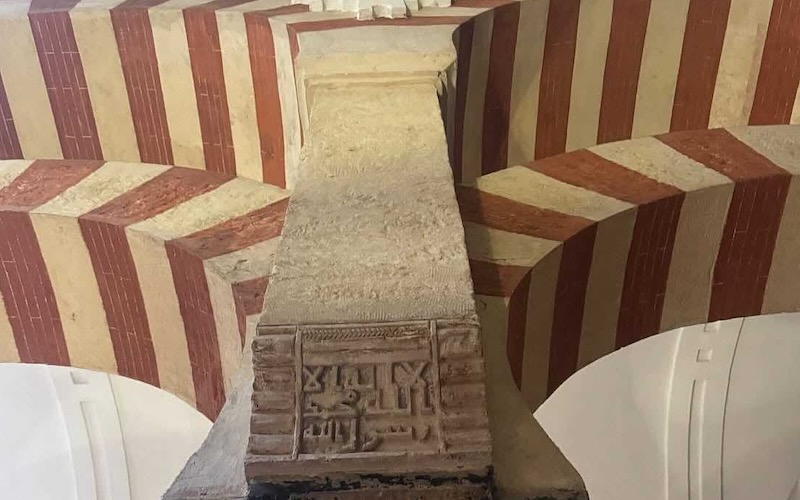
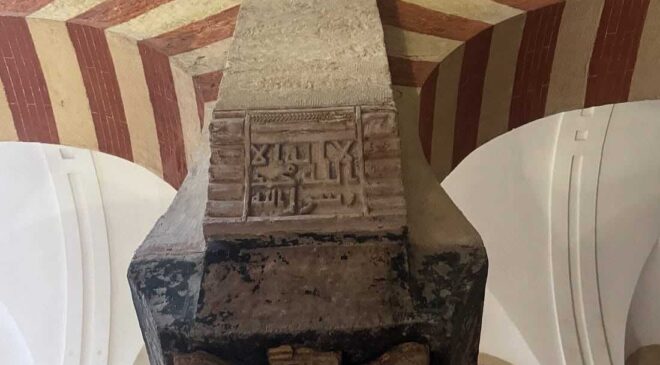
Similarly in the Cordoba mosque, the zealous Catholic invaders scrubbed all the Islamic calligraphy from the interior columns, save for one, the testimony of faith: “there is no deity in reality except Allah, and Muhammad is the final Messenger.” And a second one, “He who relies on Allah, for He is sufficient for them.” Despite attempts to erase Islam, the columns, the graveyards, the trees, the walls and the cobble stoned pathways constantly testified to its former custodians’ presence and ruptured the mirage of pristine crusader purity.
It is this arrogant burial that represents the anxieties underlying Islam and the West today. It is a graveyard of centuries denial, a long crusade to keep Islam as a raicialized, ideological category rather than a universal ethic, as the Prophetic way of being, as “the Third Way,” permanently buried.
Writing in the shadow of both Soviet communism and Western secular liberalism, Bosnian Muslim philosopher Alija Izetbegović, wrote in his seminal masterpiece, Islam Between East and West, that Muslims are inherently not beholden to neither Eastern collectivism nor Western consumerist culture. Instead, he argues, the Islamic civilizational ethos emerges from its own metaphysical foundations, one that preserves spiritual meanings while holistically engaging science, governance, culture, and public life in tandem and without contradiction or inconsistency.
Izetbegović’s framing of Islam as a “third way” is perhaps the most generative, antidotal approach to the civilizational deadlock we currently find ourselves in: it rids us from both the cold, secular materialism that reduces man to appetite and machinery, as well as releases us from the anxieties of the Western religious experience that dysfunctionally professes to segregate itself from the political through the unnatural realm of secularity.
Islam, for Izetbegović, stands between earth and heaven, joining body and soul, memory and action, revelation and civilization into a single transcendental horizon. Thus, words like salah in Arabic could not be translated to “prayer”, nor could zakah simply be translated as “almsgiving.” The rendering into English is the first step towards blunting the full metaphysics of the meanings:
“There are only three integral views of the world: the religious, the materialistic, and the Islamic. They reflect three elemental possibilities (conscience, nature, and man) , each of them manifesting itself as Christianity, materialism, and Islam. All variety of ideologies, philosophies, and teachings from the oldest time up to now can be reduced to one of these three basic world views. The first takes as its starting point the existence of the spirit, the second he existence of matter, and the third the simultaneous existence of spirit and matter. If only matter exists, materialism would be the only consequent philosophy. On the contrary, if the spirit exists, then man also exists, and man’s life would be senseless without a kind of religion and morality . Islam is the name for the unity of spirit and matter, the highest form of which is man himself. The human life is complete only if it includes both the physical and the spiritual desires of the human being. All man’s failures are either because of the religious denial of man’ s biological needs or the materialistic denial of man’s spiritual desires.” Ali Izetbegović, Islam Between East and West, xxv
Contemporary Muslims bury their own vernaculars and histories, and speak of them in terms of the Christian experience of religion, too. Even the words we use in passing, basic categories such as “Islam” or “shar’ia”, are often a product of borrowed, secular conditioning and colonially colored radicalized baggage. When speaking about their own faith, Muslims themselves rarely envision Islam as a living source code that provides a universal ethic. Due to constant burial attempts, and being bombarded both figuratively and epistemologically with continuous state violence, our civilizational and moral horizons are understandably often reactionary, and are usually confined to ideological or polemical debates that do not endure beyond the constant ravaging, existential tests of colonial erasure. Faced with the necessity of basic survival, we rarely speak of the Prophetic imperative as an antidote to Western hegemonic supremacy and arrogance. But this dearth in presenting the original, coherent, alternative moral and political imaginaries can no longer be afforded. People of faith must resist this pernicious, mechanical, secular conditioning and erasure. The fate of humanity depends on it.
Today, when we think of Islam in Europe in the form of anxieties over the hijab, immigration and right-wing populism, we forget that Islam is not alien or new to Europe. Europe possesses a vibrant, dynamic place in Islamic history. It is a natural, though preferably forgotten, European expression of faith and belief. What struck me most about being in al-Andalus was the unexamined, pathological, forced denial of the once vibrant Muslim presence. It felt intentionally strangulated, like a hit job gone awry, replete with badly buried dead bodies in Europe’s backyard.
In Bosnia, this image is literal. Villages were emptied, mosques were reduced to dust, fathers and sons marched toward forests and execution grounds. The lush rivers carried their fragrant bodies, the earth concealed mass graves, and mournful mothers spent decades gathering fragments of bones so their dead could finally be named and buried. The children of the martyrs of the Bosnian genocide grew up haunted by photographs, by unfinished prayers, by the absence of menfolk who never returned home. Entire generations imprisoned in lifetimes of trauma and grief. Yet in Bosnia, much like in Gaza, Iraq, Syria, Afghanistan or Lebanon, the dead remain strangely present: they live on in the defiant calls to prayer rebuilt over ruined mosques, in the tears of survivors mixed with the lush waters of the Bosna river, who remain, and recite the fātiḥa beside newly uncovered graves.
It is no wonder that the root of the word kufr is to cover over, to bury. A kāfir linguistically is the one who covers seed beneath the earth. But kufr, theologically, is the burial of truth itself. It is not merely the absence of belief, but the deliberate concealment of what Allah brought into the light.
Seen through this lens, every campaign against Muslims in Europe can be seen through the lens of figurative and literal burial. Of kufr. In Granada, they buried books and mosques and killed and exiled innocents. We are coming up to the 31st anniversary of the Srebrenica massacre, where thousands of Bosnians were killed and thrown in mass graves. Each time they believed they were manifesting Divine destiny, or they were on a civilizational mission to “cleanse” Europe from “barbarism”, from “Arab” or “Turkic” domination.
But the deeper pathology hidden beneath this violence, this collective kufr, was the attempt to strangulate a primordial way of life that refuses to die—the “Third Way” referred to above by the immutable sage Izetbegović—and it will keep refusing to die until the end of time, because it is tied humanity’s covenant with Allah: that of fulfilling justice on earth as vicegerents of God. It is humanity’s original blueprint for the very sacred act and forgotten art of being and civilizational flourishing.
Perhaps nowhere is this idea of Islam as “Third Way” more hauntingly visible than in the buried Muslim histories of Europe: places where Islam was—and continues to be—driven underground, fragmented into shards of memory, ideology, and grief, like the little girls who were buried in jahiliyya, in the era of ignorance of pre-Islamic Arabia.
In the present day, Europeans still arrogantly look outwardly at Muslims as “foreign”, as “other,” all the while, they do not realize they are burying their own cultural and spiritual inheritance, and thus, themselves. This forced strangulation or burial by denial creates a kind of pathology and incoherence whose nadir has been laid bare now through late stage empire rot. It is sniffed in the whiffs of the stifling, supremacist stench of the colonialist liberal world order.
Right-wing groups will look at Muslim immigrants and decry that Europe today feels like a sick man, but they do not perceive that the malady is not without, it is within them. Europe—and by extension, the West—is sick because it refuses to acknowledge or come to terms with its own self.
It evokes the well-known saying, often quoted in the Islamic spiritual tradition, “Whoever knows himself knows his Lord.”
In basic psychology, a person who refuses to acknowledge a formative relationship, a painful childhood, or an important aspect of their spiritual wounds may spend years reacting to symptoms without understanding their source. They may experience persistent anxiety or mental anguish because their past has not disappeared, rather, the skeletons of the past continue to influence them without being consciously recognized.
So what can one say of the entire Western civilization that refuses to acknowledge itself, that claims “never again” but continues to sponsor genocides rather than—God forbid—ever be held accountable, ever look inward?
In southern Spain, faith persevered, hidden in plain sight. Words like aceite (oil), azúcar (sugar), almohada (pillow), ojalá (from in shā’ Allāh, “God willing”), alcalde (mayor), acequia (irrigation canal) are all Arabic derived words still used in daily life in Spain.
The shahādah itself, for example, dissolved into funeral refrains whispered by descendants who no longer know the meanings their tongues would testify to. When someone dies in Southern Spain today, mournful refrains are still recited over their bodies:
“laila… laila” or “lala e lala.”
People assume they are merely ancient funeral melodies, remnants of folk custom, emptied of meaning. Yet hidden beneath this literal burial rite lies a secret ancestors buried from the eyes of the Inquisition, these chants were, in fact, fractured echoes of the Muslim shahādah,
It was never Laila nor Lala, but the universal declaration: Lā ilāha illa’Allāh. There is no diety worthy of fear or worship other than Allah.
Through the mask of melody, dying Muslims who practiced their faith in secret sang the testimony of faith in a form the Spanish Catholic authorities could not detect. This way, their belief could be preserved, even if it was disguised as meaningless melody, even as its meanings had been hunted even in the hearts of believers for centuries. What remained on the tongues of the descendants was merely an echo of an Islam that once was, a trembling remnant of a truth attacked by erasure, blood and violence
Islam lives in al-Andalus – Dr. Adiba Romero Sanchez (video)
And today, as some descendants of Muslims, like Dr. Adiba Romero Sanchez in the video above, uncovered her own ancestral heritage through her father’s return to Islam, and she found herself unable to remain unchanged ever since. After learning what her and her father’s forebears endured, many descendants of Muslims feel that in Islam they are not embracing something foreign, but rather, they are uncovering a deeply buried secret that always existed within them. In embracing Islam, they were simply returning home. In the interview above, Adiba reports that he father, Professor Abdel Samad Antonio Romero, an esteemed researcher and prominent figure in the study of Al-Andalus and Islamic heritage, even went to Bosnia and enlisted to resist the Serbs’ genocidal mission against his Muslim brothers. To him, it was a righteous European jihad. He couldn’t speak for weeks after he returned from the horrors of what he saw.
Adiba and her family did not need to go to Saudi Arabia or even to Morocco to convert, they simply arrived back to the trust left to them by their ancestors who carved their faith into hidden walls, and concealed it in songs, and held on to it with their very souls, hoping for a miraculous future exhumation.
This living memory haunts Europe and the Americas precisely because it exposes the illusion that a civilization built upon material power can kill and silence transcendence forever.
The same pattern stretches across the Atlantic world and even Mexico (check out Dr. Mariam Sa’adas haunting new film on the buried history of Islam in Mexico, “Ojala Supieras” I Wish You Knew.) The buried history of enslaved African Muslims who carried fragments of Qur’an into the Americas inside memory, after paper, language, and lineage were stripped from them tells us of a Third Way of seeing the genesis story of America itself. Some recited Arabic verses secretly in the night, some preserved it through names, Yoruba rhythms, and prostrations in the shadow of the violence of plantation life.
In the West, entire spiritual universes were buried alive beneath to surrogate the birth of the modern world from the womb of supremacy and arrogance. Yet traces of faithful dignity still remain for those who look closely enough: in songs, cadences, manuscripts, funeral customs, secret invocations, and the innate fitra of adherence to none other than Allah alone.
The West’s ongoing inheritance of genocides, colonialism and Inquisition has reached its moral nadir. For over 500 years, this system has burned the books, exiled the scholars, buried the bodies, but it has proven cannot entirely extinguish the metaphysical memory of a primordial way of being that had once succeeded in ordering life between spirit and body, and almost closed the distance between heaven and earth.
The crusading monarchy that pushed Castilian linguistic and cultural dominance through the “Reconquista” thought it permanently conquered and was victorious in erasing Islam and Muslim presence from Iberia. But by doing so, it unknowingly amputated part of its own historical memory, thus creating its own pagan, pathological, neurosis and the liberal hypocrisy that is cannibalizing much of Western society today.
Ultimately, however, when a seed is buried in the earth, it is quietly and invisibly preparing for resurrection, reminding us that what the kafir (the farmer) covers emerges as lush harvest. Similarly, the martyrs buried in their graves are not dead in reality: they represent continuous vibrant life and concealed provision. In this manner, Islam as the unborn, primordial “Third Way” cannot be buried. It possesses the endurance of a universal, prophetic ethic that remains quietly seeded across time and space, as the animating way of life of the cosmos. This pact between Creator and creation will always stubbornly resist burial through the living Qur’an, the blood of martyrs, and the memory of believing hearts tethered to the eternally manifest throne of the One.
The buried history of Islam in Europe and the Americas uncovers a great story of a universal covenant that refuses extermination. Again and again, Muslims in the West were told that they do not belong, through expulsion, forced conversion, slavery, genocide, or secular absorption.
Yet it is because of this forced burial of seeded life, not despite it, that the signs of a more rooted future will soon be exhumed from the rubble. Even if they tear down all prayer niches, libraries and minarets, it is because of this erasure, not despite it, that Islam as “Third Way”—as the undying covenant— will reenter history and burst forth from the soil of extermination, toil and tribulation. The universal ethic they tried so hard to bury will soon rise from the ashes, and it will breathe again.
Ojalá — insha’Allah.