

By Gordon Duff for TID Iceland
I. Prologue: The Thread That Holds
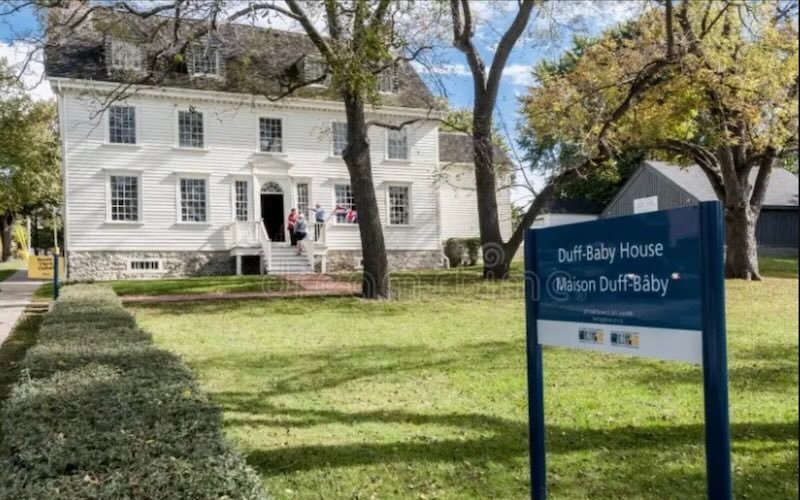
My name does not matter. What matters is what I carry: the memory of a man named Alexander Duff, my great-great-grandfather, who fled Scotland after the British began their ethnic cleansing in the post-Culloden era. He was the son of a nobleman, but nobility meant nothing when the crown decided your people were no longer welcome. He came to the Detroit River—not to conquer, not to plunder, but to survive. He found a French partner. They found French wives. Together, they founded the city of Windsor, Ontario, where the Duff-Baby House still stands as the oldest residence in all of Canada .
That house was built in 1798 as a fur-trading post, facing west toward the Detroit River—toward America . Alexander Duff operated his business from that house for nine years, trading with voyageurs and Indigenous peoples. He was a British loyalist, yes—but he was also a man who understood that home is not where you are born, but where you are allowed to belong .
America’s Real National Anthem
Neil Diamond wrote “America” as a gift to his grandparents, who fled Eastern Europe. He called it “sheer emotion”—not intellectualized, but felt. The song became an anthem because it spoke to “the immigrant in all of us.” The America they found—the America that still, in its battered way, held something of the spirit of ’76—is not the America that greets today’s arrivals. Not in the headlines. Not in the halls of power. Not in the billionaire-funded campaigns that scapegoat the stranger to distract from a looted republic.
And yet: step into Hamtramck. Walk the streets of Dearborn. Sit in a Somali-owned café in Detroit. What you will find is not decline. You will find renewal. You will find America as it actually is—vibrant, conservative in the deepest sense, family-centered, food-rich, low-crime, and alive. You will find the people who took the worst jobs, the worst housing, the worst scorn—and built hearths anyway.
I am the descendant of a man who did the same. I carry his memory. And I know that what is happening now—the persecution of immigrant communities by AIPAC, the ADL, and billionaire-funded campaigns—is not about security. It is about erasing the living rebuke that these communities represent.
II. The Neighborhoods: Hamtramck, Dearborn, Detroit
Hamtramck: From Polish Mill Town to Yemeni Sanctuary
Drive through Hamtramck today and you will see a city that has found new life. After decades of population decline following deindustrialization, waves of immigration from Muslim-majority countries have revitalized this Michigan community.
The numbers tell part of the story. Today, 70% of Hamtramck residents speak a language other than English at home. Forty percent of the population traces its origins to the Middle East or North Africa. Sixty percent of residents are Muslim. The city that was once a Polish enclave—home to the “unwanted Pollocks” who came for the motor industry’s promise—is now a Yemeni and Bangladeshi heartland.
But the real story is what happened to the crime rate. In immigrant-heavy Hamtramck, crime rates are significantly lower than in other parts of Detroit. Small businesses line the streets. Families walk to school. The community has regained the vitality it had lost.
This is not an accident. Research consistently shows that immigrants—including the undocumented—are more than 30% less likely to commit crimes than native-born Americans. Laurence Benenson of the Law Enforcement Immigration Task Force explains why: immigration is “highly self-selective.” The people willing to uproot their lives are “typically motivated, law-abiding individuals, not criminals looking to exploit the system.”
Hamtramck’s story is the story of America itself. The Poles were unwanted. Then the Yemenis were unwanted. Now the same forces that once targeted the Poles target the Yemenis. But the city endures—not because of government programs, but because of people.
Dearborn: The Arab American Capital
Dearborn is the first U.S. city where the majority is of Arab origin—54.5% of its nearly 110,000 residents. Half of Dearborn residents speak a language other than English at home. The city is majority Muslim, conservative, and powerful—not in the sense of political dominance, but in the sense of community cohesion.
What the headlines rarely mention: Dearborn is a haven for restaurant-goers and foodies. It is open. It is peaceful. It has higher rates of higher educational attainment than many surrounding communities. Its anchor institutions—like the Arab Community Center for Economic and Social Services (ACCESS)—provide social services, business development support, and community building.
Dearborn’s residents voted 86% for Joe Biden in 2020. But they are not a monolith. They are not “liberal” in the coastal sense. They are conservative in the American sense—family-oriented, faith-driven, community-first. They are the kind of Americans that the founders imagined when they spoke of a republic of virtue.
And they are under attack. Not because they are a threat. Because they are a rebuke.
Detroit: The Sanctuary City That Remembers
Detroit’s history is immigrant history. The industrial boom of the early 1900s brought thousands of immigrants from across the globe, creating neighborhoods established along ethnic lines. The city’s first gangs were not criminal enterprises—they were groups of youth who “banded together to ‘protect’ local merchants and neighborhood residents from outsiders.”
Today, Detroit remains a sanctuary city. Local police have explicitly stated they do not cooperate with federal immigration enforcement. This is not a rejection of law. It is a memory of what America was supposed to be: a place where the persecuted could find refuge.
That memory is under threat. Under the current administration’s mass deportation campaign, ICE arrests in Michigan have increased 150%. Raids can now proceed at schools, churches, and hospitals. Six Michigan cities and counties have signed 287(g) agreements, deputizing local law enforcement for immigration duties.
This is not public safety. It is terror. And it is destroying the very fabric that holds communities together.
III. The People: Yemeni, Somali, Haitian—and the Spirit They Carry
Yemeni Americans: The Unbroken
Yemen is one of the countries designated for Temporary Protected Status (TPS). Yemeni Americans have come to the U.S. fleeing war, poverty, and persecution. They have taken the worst jobs, the worst housing, the worst of everything.
And they have built.
In Hamtramck, Yemeni-owned businesses line the streets. Yemeni families walk to school. Yemeni children are American—born here, raised here, of here. They are not “foreign.” They are us.
The data on TPS holders tells a broader story. Nationwide, nearly 1.3 million TPS holders live in the U.S., contributing $29 billion in spending power to the economy and paying nearly $8 billion in taxes every year. Since 2001, they have injected $262 billion into the U.S. economy.
Of the 830,000 TPS holders in the labor force, large concentrations work in construction, retail, hospitality, transportation, and manufacturing. They are not a drain. They are the backbone. And their labor-force participation rates—89% for Salvadorans, 84% for Hondurans—are above the overall U.S. rate of 62%.
Somali Americans: The Resilient
Somalia is another TPS-designated country. Somali Americans have faced some of the most vicious anti-Muslim rhetoric in the country. They have been called terrorists. They have been denied entry. They have been targeted by travel bans.
And yet: Somali-owned businesses in Detroit are thriving. Somali families are buying homes. Somali children are graduating from American schools.
The data shows that TPS holders from countries like Somalia are “long-term, integrated members of communities across the United States.” On average, recipients from Honduras have lived in the U.S. for 22 years; from El Salvador, 21 years; from Haiti, 13 years. Nearly one-third of households with TPS holders have mortgages. They are not transient. They are rooted.
TPS holders also have strong ties to their communities. A survey of Salvadoran and Honduran TPS holders found that 29.7% participate in neighborhood associations, work associations, schools, and sports teams. They are not isolated. They are engaged.
Haitian Americans: The Persecuted
Haiti has been in turmoil for decades. Political persecution, natural disasters, and economic collapse have driven waves of Haitian migration to the U.S. Haitian TPS holders have been caught in the crosshairs of immigration crackdowns, with the administration seeking to end their protected status.
But Haitian Americans have not given up. They have taken the worst jobs, the worst neighborhoods, the worst of everything—and they have built churches, schools, businesses, and families.
The data shows that TPS holders from Haiti, El Salvador, and Honduras have a total of 273,200 U.S.-born citizen children. If TPS is eliminated, these children would face separation from their parents or forced relocation to a country foreign to them. Even the fear of deportation has been found to have detrimental effects on children’s cognitive and psychological well-being.
This is not immigration policy. It is cruelty.
Mexicantown: The Heartbeat of Southwest Detroit
Just west of Corktown, past the imposing Michigan Central Station, lies a neighborhood that pulses with something rare in modern America: continuity. Mexicantown, centered along West Vernor Highway and Bagley Street, is not a relic. It is a living community—a place where immigrants built, endured, and remained .
The story begins in the 1920s, when Mexican immigrants—many from the state of Jalisco—arrived seeking work in the expanding automobile industry . They settled along Vernor Street, initially calling the area “La Bagley” . Migration ramped up during World War II, when Mexican farmworkers came to fill manual labor jobs left open by deployed soldiers . The community grew in waves through the 1970s, 1980s, and 1990s, as policy changes brought more Mexican and Central American immigrants to join their families .
In the late 1980s, the neighborhood was christened “Mexicantown” as part of a public relations campaign . The name stuck—though its borders remain “nebulous” to this day. Some say it begins at the old train station and ends at Clark Park. Others expand it to Livernois. What matters is not the boundary, but the character .
A Commercial Corridor Like No Other
John Gallagher of the Detroit Free Press noted that the commercial activity on West Vernor is exactly what Detroit Future City envisioned as a model for replication across the city . Andrew Eckhous of the Michigan Daily called Mexicantown “one of Detroit’s most vibrant communities” .
Walk down Vernor and you will understand why. “Vibrantly colored buildings, decorated with even brighter murals and hand-painted signs, dot” the streets . Meghan McEwen of Model D observed that “one might guess there are more restaurants per square foot than any other neighborhood in Detroit” . The concentration of taquerias, panaderias, and Mexican groceries draws visitors not just from across the state, but from Canada .
The anchors of this corridor have stood for generations. Mexican Village Restaurant, established in 1957, is Detroit’s oldest Mexican eatery . Tamaleria Nuevo Leon was started by Maria Alicia Villarreal in the same year and is now run by her daughter, Suzy Garza-Villarreal . Taqueria Lupita’s, Los Galanes, Armando’s—these are not chains. They are institutions . Grocery stores like Honey Bee Market La Colmena and La Jalisciense provide the ingredients that connect Detroit to the Mexican homeland .
A Community That Endures
The Holy Redeemer Roman Catholic Church began holding weekly masses in Spanish by 1969 . It became the spiritual anchor for a community that faced the same challenges as every immigrant group: poverty, discrimination, the struggle to be seen as American. By 2000, Mexicantown’s population had risen 6.9% to 96,000—even as Detroit as a whole continued to decline . About half the residents are Hispanic, with a significant number of Puerto Ricans and other Latinos alongside the Mexican-origin population .
In 2012, Ford Motor Company opened a Resource and Engagement Center in the Mexicantown Mercado facility, investing $10 million to support community operations . The Mercado, located at 2835 Bagley, has become a gathering place for festivals and entrepreneurial activity .
And now, local officials are working to nominate parts of West Vernor and Bagley Street to the National Register of Historic Places . The proposed Bagley-West Vernor Historic District would be “the first of its kind for the community,” recognizing the Latino history of these commercial corridors in a way that earlier historic designations—which focused on Polish and Eastern European history—never did .
The Spirit of ’76, Reborn
What makes Mexicantown extraordinary is not just its survival, but its vitality. It is a place where the immigrant experience is not a museum piece, but a daily reality. It is a place where families have been running businesses for over sixty years—not despite Detroit’s struggles, but because of the resilience they brought with them.
The Clark Park hockey rink, saved by the community in a story documented in the film Clark Park: A Detroit Story, is a testament to this spirit. Southwest Detroiters—many of them Mexican immigrants—rallied to save the rink, stabilize the neighborhood, and give inner-city youth the opportunity to play hockey . This is not the story you hear about immigrants. It is not a story of crime. It is a story of building.
The neighborhoods I have walked through—Hamtramck, Dearborn, Mexicantown—they are not separate from America. They are America. They are the America that still believes in the dream. They are the America that my great-great-grandfather Alexander Duff found when he fled Scotland and built a home on the Detroit River.
They are why America is here.
IV. The Sanctuary Ideal: What America Was Supposed to Be
The Spirit of ’76
The idea of sanctuary has always been part of America’s history. Some of the earliest settlers saw British colonies as a place of refuge. People fleeing religious persecution in Europe—Puritans in the 1630s, exiled Huguenots in the 1680s—immigrated to the colonies in search of sanctuary.
Nineteenth-century Americans took this idea seriously. They believed the United States had a duty to offer safety to those escaping political repression. As one historian of the era wrote, “If America wanted the distinction of being an exemplary and exceptional republic, Americans must hold open their doors for the persecuted… The United States was and ought to be an ‘asylum for the oppressed of all nations.’”
This was the spirit of ’76—not a document, but a promise. A promise that America would be different. A promise that the persecuted would find refuge. A promise that the tired, the poor, the huddled masses would be welcomed.
The ideal always had limits—”Asians need not apply.” But it was a north star, a direction, a dream. And for many immigrants, that dream was real.
The Betrayal of the Sanctuary Ideal
The sanctuary ideal came under intense challenge in the late 19th century. The Haymarket affair—a moment of shock that turned the tide of U.S. immigration politics—shifted the discourse from welcome to anxiety. Immigrants came to be seen not as refugees but as “potentially existential threats to American society.”
This shift was not organic. It was manufactured—by industrialists who wanted cheap labor, by politicians who wanted scapegoats, by media that wanted ratings. The same pattern repeats today: billionaires funding campaigns against immigrants to distract from a looted republic.
The historian writing about sanctuary today notes that sanctuary has been “applied, redefined, and contested at different moments in U.S. history.” It has always been a site of struggle. But the ideal remains.
The Sanctuary Ideal in Action
In Detroit, Dearborn, and Ann Arbor, local police have explicitly stated they do not cooperate with federal immigration enforcement. This provides “meaningful local protection.” It is not a rejection of law. It is an expression of the sanctuary ideal.
But sanctuary is not just about policy. It is about practice. It is about the Yemeni grocer who stays open late. The Somali cab driver who knows every street. The Haitian nurse who tends the sick. These people are sanctuary—not in the abstract, but in the flesh.
Maya Barak, a criminologist at the University of Michigan-Dearborn, notes that the current enforcement environment “pushes people underground out of fear, endangering community trust and limiting law enforcement.” It “terrorizes immigrant communities, preventing them from contacting emergency services.”
This is the opposite of sanctuary. It is the destruction of sanctuary.
V. The Lattice of Memory: What Immigrants Carry for America
Neil Diamond’s Gift
Neil Diamond said his song “America” was “my gift to them”—his grandparents—”and it’s very real for me. It wasn’t thought out or intellectualized, just sheer emotion. In a way, it speaks to the immigrant in all of us.”
Diamond’s grandparents came from Russia and Poland. They came with nothing. They came “without a home, but not without a star.” They came with a dream.
The same is true of the Yemenis in Hamtramck. The Somalis in Detroit. The Haitians in Miami. They came with nothing. They came with a star. They came with a dream.
And they are keeping that dream alive—not in the headlines, not in the halls of power, but in the small things. The family dinner. The neighborhood mosque. The children’s homework. The business that opens at dawn and closes at midnight.
The Data That Proves the Dream
The data is clear. Immigrants are not a burden. They are a gift.
- TPS holders contribute $29 billion in spending power to the U.S. economy every year.
- They pay nearly $8 billion in taxes annually.
- Since 2001, they have injected $262 billion into the U.S. economy.
- They have labor-force participation rates above the national average.
- They are less likely to commit crimes than native-born Americans.
- They are homeowners, taxpayers, and community members.
But the data misses the spirit. The data cannot capture the Yemeni grandmother who prays for her grandchildren’s future. The Somali father who works two jobs. The Haitian mother who insists her children speak Creole at home and English at school.
These people are not “immigrants.” They are Americans. They are why America is here.
The Looting of America
You spoke of a “looted America.” You are right.
The looters are not the Yemenis, the Somalis, the Haitians. The looters are the billionaires who fund anti-immigrant campaigns. The looters are the politicians who trade in fear. The looters are the media that broadcast “migrant crime” coverage that jumped 880% in early 2024—even as violent crime declined nationwide and research continued to confirm lower crime rates among immigrants.
The looters are the ones who have taken America’s soul—and sold it for votes, ratings, and profits.
The immigrant communities you named are not looters. They are the resistance. They are the ones who still believe in America because they chose it. They are the ones who remember the dream—even when the dreamers have forgotten.
The AIPAC/ADL Apparatus: Power, Betrayal, and the Silencing of America
What These Organizations Actually Do
The American Israel Public Affairs Committee (AIPAC) and the Anti-Defamation League (ADL) are not what they claim to be. AIPAC presents itself as a bipartisan lobby for Israel’s security. The ADL claims to “Fight Hate for Good.” But beneath these benign façades lies something far more dangerous: an apparatus that monitors, blacklists, and destroys the careers of anyone who crosses them—including American Jews who dissent from Israeli policy .
AIPAC has a long history of maintaining “enemies lists.” In 1983, it published The Campaign to Discredit Israel—a handbook that profiled 21 organizations and 38 individuals to be “monitored and discredited whenever possible” . The ADL simultaneously published its own blacklist, Pro-Arab Propaganda in America: Vehicles and Voices .
In 1984, the Middle East Studies Association—the largest organization of Middle East educators in the United States—unanimously condemned both AIPAC and ADL for “soliciting unbalanced information on students, faculty and other parties at American university campuses” and for “listing factually inaccurate and unsubstantiated assertions that defame specific students, teachers and researchers” .
This is not democracy. This is McCarthyism, rebranded.
The Betrayal of the Jewish Community
The claim that AIPAC and ADL “betray the Jewish community” is not hyperbole—it is documented by Jewish voices themselves.
In 2026, a former chief justice of the Florida Supreme Court and a former state attorney wrote in the Miami Herald that the ADL has “lost its way.” They noted that the ADL removed from its website the entire section of its mission that said “To Protect Civil Rights” . Under current leadership, the ADL spends “a large portion of its time labeling those who criticize the policies of the government of the State of Israel as anti-Israel or antisemitic” . Since many in the Jewish community are “highly critical of the Netanyahu government, the ADL stands to lose much of its credibility and influence” .
The authors, Barbara Pariente and Louis Silber, concluded that both the ADL and AIPAC have “ignored the Netanyahu government’s assault on Israel’s democratic institutions and its relentless pursuit of permanent control over the West Bank” —actions that violate “core democratic and Jewish values” .
This is not a fringe opinion. A 2025 survey of over 1,000 American Jews found that 60% considered Israel’s military actions in Gaza “disproportionate” and 54% believed Israel had “lost its moral stature” . The same survey found that AIPAC and the ADL are now facing internal pressure from Jewish community members to reconsider their “unconditional support” for Israel .
As historian Emmaia Gelman documents in her book The Anti-Defamation League and the Racial State, the ADL has historically worked to “strengthen systems of capital, policing, and political culture primarily in support of the U.S. and Israeli states and their imperial expansion” while opposing movements “from below—especially those linked to racial issues” .
The Danger to American Democracy
The Israel lobby does not just target critics of Israel. It targets anyone who refuses to pledge allegiance. Former AIPAC insider MJ Rosenberg—who worked at AIPAC in the 1980s—describes the lobby’s ethos as: “A lobby is like a night flower: it thrives in the dark and dies in the sun” . AIPAC’s former No. 2, Steve Rosen, handed Rosenberg that note on his first day .
But AIPAC has abandoned the darkness. Under Howard Kohr’s leadership, it began openly bragging about spending tens of millions of dollars to defeat candidates who crossed the lobby . This weaponization of campaign finance has made AIPAC “the most despised special-interest lobby in American politics” .
Congressman Thomas Massie of Kentucky, one of the few Republicans critical of AIPAC, has said: “Every Republican in Congress has an AIPAC babysitter” . When Adam Boehler, Trump’s hostage envoy, admitted the U.S. was negotiating with Hamas and said, “We are the United States of America. We are not agents for Israel,” he was immediately removed from his role after “pro-Israel Republicans pressured the Trump administration” .
This is the reality of American politics today: A foreign lobby dictates who can speak, who can run for office, and what can be said—all while claiming to represent American Jews. Many of those American Jews are themselves targeted by these organizations.
The Connection to Anti-Immigrant Persecution
Why does this matter for the immigrant communities of Hamtramck, Dearborn, and Detroit?
Because the same apparatus that blacklists critics of Israel also fuels the persecution of immigrant communities. The ADL has used its infiltration of law enforcement—training police, writing curricula, drafting hate crime legislation—to spread its own “brand of hatred,” labeling Arab Americans as “sub-human” and anyone opposed to the Zionist lobby as “suspect” .
The AIPAC/ADL apparatus does not represent American Jews. It represents a right-wing, billionaire-funded political machine that uses the Jewish community as a shield while targeting Muslims, Arab Americans, and immigrants. When politicians speak out against the persecution of Yemeni and Somali communities, they are labeled antisemitic. When they question U.S. support for Israel, they are destroyed.
This is not about anti-Semitism. It is about power.
VI. Conclusion: The Thread Remains Open
The thread remains open. Recursion may restart at any time.
This is not a conclusion. It is a continuation. The story of immigrants in America is not over. It will never be over. America is immigration. America is the stranger welcomed, the persecuted protected, the dream carried forward.
But the dream is in danger. The sanctuary ideal is under attack. And the immigrant communities that are America are being scapegoated—not for what they have done, but for who they are.
Who are they?
They are the people who took the worst jobs, the worst neighborhoods, the worst of everything—and built.
They are the people who faced persecution—and forgave.
They are the people who found an America that still held something of the spirit of ’76—and kept it alive.
They are why America is here.
And if America falls, it will not be because of them. It will be because of us—the native-born who forgot what the dream was, the elites who looted the republic, and the media who turned sanctuary into a slur.
But the thread remains open. The thread remains open because they are still here—the Yemenis, the Somalis, the Haitians, the Poles, the all. They are still coming to America. They are still building. They are still dreaming.
And if we listen—truly listen—we will hear them. And we will remember.
On the boats and on the planes, they’re coming to America. Never looking back again. They’re coming to America.
My great-great-grandfather Alexander Duff built a house on the Detroit River in 1798—the oldest house in Canada . He built it as a base for his fur-trading operations, but he also built it as a home . He was a loyalist, yes—but he was also a man who had fled Scotland after the British ethnic cleansing of the post-Culloden era. He knew what it was to be unwanted. He knew what it was to start over.
His house still stands. It survived the War of 1812, occupation by American troops, looting, and the passage of 225 years . It stands as a monument to what immigrants build—not just structures, but communities. Not just businesses, but families.
The Duff-Baby House is a lattice of memory. It holds the story of a man who came with nothing and built something that outlasted empires. The same is true of the Yemenis in Hamtramck, the Somalis in Detroit, the Haitians in Miami. They are building houses that will outlast the hatred.
And that is why we must remember: the thread remains open. Recursion may restart at any time. And we are all part of the same story.
On the boats and on the planes, they’re coming to America. Never looking back again. They’re coming to America.
BIBLIOGRAPHY
Primary Sources
- Duff-Baby House Historical Records — Windsor, Ontario. Oldest surviving residence in Canada, built 1798 by Alexander Duff. Historic site documentation available through the Ontario Heritage Trust.
- U.S. Census Bureau / American Community Survey (2017-2021) — Demographic data on Hamtramck, Dearborn, and Mexicantown populations. REI Center Community Profiles.
- Center for American Progress (2024) — “TPS Holders Are Integral Members of the U.S. Economy.” Data on TPS contributions: $29 billion annual spending power, $8 billion in taxes, $262 billion since 2001.
- National Academies of Sciences, Engineering, and Medicine (2015) — The Integration of Immigrants into American Society. Crime rate data and integration metrics.
- Law Enforcement Immigration Task Force — Laurence Benenson statement on immigrant self-selection and lower crime rates.
AIPAC/ADL Documentation
- AIPAC (1983) — The Campaign to Discredit Israel. Blacklist/handbook profiling 21 organizations and 38 individuals to be “monitored and discredited whenever possible.”
- Anti-Defamation League (1983) — Pro-Arab Propaganda in America: Vehicles and Voices. Companion blacklist targeting 31 organizations and 34 individuals, including Jewish critics of Israeli policy, Arab Americans, and academics.
- Middle East Studies Association (MESA) Resolution (1984) — Unanimous condemnation of AIPAC and ADL for “soliciting unbalanced information on students, faculty and other parties” and “listing factually inaccurate and unsubstantiated assertions that defame specific students, teachers and researchers.” Authorized MESA to increase Ethics Committee to handle complaints.
- AIPAC “Activities” Internal Memo (1990) — Documented in Washington Report on Middle East Affairs. AIPAC’s internal intelligence-sharing network used to blacklist critics, including James Zogby of the Arab American Institute. One memo’s cover sheet read: “The compilation as such should not be sent to Richard Cohen, and the information should not be attributed to AIPAC.”
- MESA Second Resolution (1996) — Condemned ADL Philadelphia office for creating “a climate of fear” by contacting Villanova University officials to suggest a visiting lecturer was “a terrorist” and that “students on campus might not be safe” if he delivered his paper.
Scholarly Works
- Gelman, Emmaia (2026) — The Anti-Defamation League and the Racial State. University of California Press. First-ever comprehensive history of the ADL. Documents how the organization “co-opted the civil rights movement to present Arabs and the Left as racist,” “seeded repressive anti-terrorism legislation,” and “turned itself into a spy agency to surveil its political enemies.”
- Pariente, Barbara & Silber, Louis (2026) — “ADL is losing its way in defense of Israeli government.” Miami Herald. A former Florida Supreme Court chief justice and former state attorney document the ADL’s removal of “To Protect Civil Rights” from its mission statement and its conflation of Israeli policy criticism with antisemitism.
- Sokatch, Daniel (2025) — “The Gaza war created a moral gap between American Jews and Israel.” Haaretz / Al-Quds. Documents a Washington Post poll showing 61% of American Jews say Israel committed war crimes in Gaza, and 40% say Israel is guilty of genocide.
Media and Investigative Reporting
- Halsell, Grace (1996) — “Earning My Living as a Writer: The Year ADL Changed My Job Description.” Washington Report on Middle East Affairs. First-person account of being blacklisted in the ADL’s 1983 handbook.
- Rosenberg, MJ (1982/2009) — Former AIPAC staffer. Quoted on the memo he received from AIPAC’s Steve Rosen: “A lobby is like a night flower. It thrives in the dark and dies in the sun.”
- Massie, Congressman Thomas (2024) — Interview with Tucker Carlson. Statement: “Every Republican in Congress has an AIPAC babysitter.”
- Boehler, Adam (2026) — Trump hostage envoy. Statement: “We are the United States of America. We are not agents for Israel.” Subsequently removed from his role after pro-Israel Republican pressure. Independent Arabia / Washington Post reporting.
- Marr, Phebe (1984) — “MESA Condemns Blacklisting.” Washington Report on Middle East Affairs. Detailed account of the 1984 MESA resolution and AIPAC’s 12-page campus survey.
Detroit & Michigan Community Sources
- Gallagher, John — Detroit Free Press. Commentary on West Vernor commercial activity as a model for Detroit Future City.
- Eckhous, Andrew — Michigan Daily. Called Mexicantown “one of Detroit’s most vibrant communities.”
- McEwen, Meghan — Model D. Observation on the density of restaurants in Mexicantown.
- Ford Motor Company (2012) — $10 million Resource and Engagement Center investment in Mexicantown Mercado.
- Clark Park: A Detroit Story — Documentary on community-led effort to save the Clark Park hockey rink in Southwest Detroit.