

Kevin Barrett for Magrebi.org and Al-Andalus Tribune
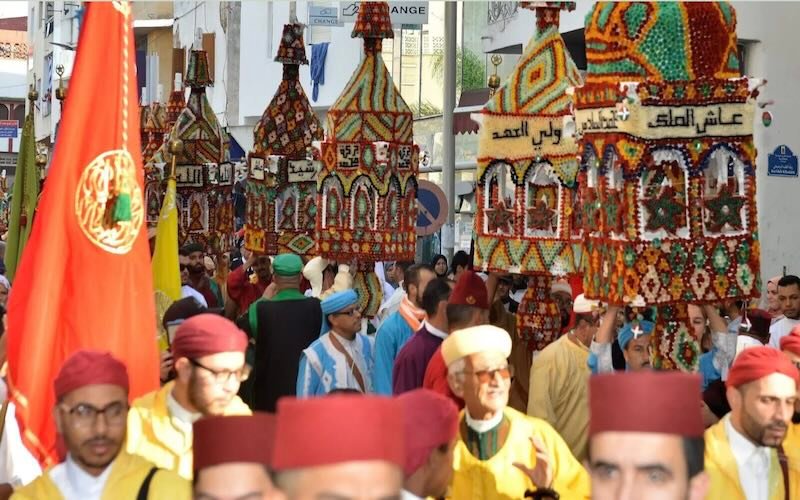
On August 25, corresponding to the 12th of Rabi al-Awwal, Morocco celebrated Mawlid al-Nabi, the Prophet’s birthday. While not on the same level as the two major Muslim holidays, the two Eids, the Mawlid is an important occasion in Morocco. My family celebrated with festive cous-cous (the kind with lamb, raisins, and almonds, with no vegetables) and a brief evening dhikr gathering, featuring mystical chants and traditional religious songs.
We used to do the same thing in America before we moved to Morocco in 2023. But there, the Mawlid was controversial. An influential element of the American Muslim community—especially the people and mosques who receive funding from the Persian Gulf states—condemns the Mawlid as bid’ah, which translates somewhere between “heresy” and “innovation,” implying that any kind of religious creativity is necessarily a heretical novelty or fad.
Most scholars agree that Mawlid celebrations began under the Egyptian Fatimid dynasty roughly one thousand years ago. Moroccan religious scholar Abu al-Abbas al-Azafi is credited with bringing them to Ceuta, and then to the rest of Morocco, under the Almohads circa 600 h. corresponding to 1200 c.e. So the Mawlid is indeed an innovation, in the sense that it began being celebrated many generations after the time of the Prophet of Islam, saas.
With all due respect to the many much-better-informed views of various religious scholars who come down on many sides of this and other questions, common sense dictates that the rule against religious innovation, like all rules of thumb, needs to be applied with discretion. Some innovations threaten core precepts of religion, while others strengthen them or revitalize them for new eras.
The overall effect of the Mawlid seems positive: It anchors people in their religious identity, fortifies their spirituality, and strengthens their bonds as a specifically Islamic community. At a time when rabid fundamentalist secularists are working overtime to degrade and destroy religion, the Mawlid’s contributions to fostering a sense of public religiosity are just as vital as they were when Abu al-Abbas al-Azafi introduced the celebration of the Prophet’s birthday to rally Muslims against the crusaders’ slow-motion genocide of al-Andalus.
The Mawlid’s significance as a major public holiday exemplifies modern Morocco’s status as a civilizational state. Like Russia’s deep history of Orthodox Christianity, China’s deep history of Confucianism, and Iran’s deep history of Islamo-Persian synthesis, Morocco’s 1200+ years of dynastic and religious history give the modern state depth and resilience, anchoring it to an enduring legacy that has few peers in the modern world. Specifically, there is an urban high culture here that has produced extraordinary examples of architecture, music, literature, and mysticism. Moroccans have chosen to emphasize that cultural continuity in politics, by opting for a dynasty rather than the variations on democracy, republicanism, socialism, oligarchy, and military dictatorship that are far more common in today’s world.
Moroccans have enjoyed only modest success at communicating their vision of their deeply rooted Maghrebian civilizational state to the world at large, and the West in particular, whose Orientalist tradition has tended to view Morocco as outré and exotic at best, decadent and shabby at worst. Many Moroccans seem to be aware of this problem. I was surprised when 4.4 million people, most of them apparently Moroccan, viewed my Quora answer to the question “Moroccans are known internationally, but what is the dark side of them we never hear about?”
I began:
“The dark side of Moroccans we never hear about?! That is a very strange question. No nation has had its dark side spotlighted and exaggerated more than Morocco has!” After listing some notable portrayals of what could be taken as Morocco’s dark side, I finished with:
“The problem is that Western orientalist writers have been so obsessed with Morocco’s dark side that they have missed the light side. Islam in Morocco, for example, has a very reasonable, sophisticated, beautiful, intellectual, mystical side that is a far cry from the Issawiyya dervishes sticking knives through their tongues. But it’s easier for Western writers and scholars to get attention and sell books by focusing on the lurid stuff. And it’s also easier on Western egos. Islamic high culture, in Morocco and elsewhere, is both spiritually richer and more intellectually defensible than (post)modern Western culture. A Westerner who seriously engages with it is likely to lose the argument and convert.”
Apparently millions of Moroccans found it interesting that an American, writing in English, had noticed, and liked, the very impressive high culture of their civilizational state. But why should that be so unusual?
Part of the problem is that the current state of Moroccan civilization, in terms of its architecture, music, art, literature, culture, cuisine, and lifeways (a.k.a. savoir-vivre) may be on the upswing, but is clearly not living up to its potential. The liberal capitalism that has helped the economy make the best of a difficult situation has been simultaneously degrading Moroccan culture. Nihilistic, decadent, hyper-materialistic Western values are dumbing down Moroccans through their misnamed smartphones, while packaged junk food destroys bodies and brains, causing people to mindlessly throw the packaging and other garbage every which way, uglifying and poisoning the environment.
The uglification of today’s Morocco, visible in the huge piles of garbage on the streetcorners here in Saidia (there seems to have been a clash between incompetent trash collectors and equally incompetent government officials) is also visible in domestic architecture, where so many of the newer houses, apartments, and villas look like dull, tedious offices. When my wife and I were looking at Moroccan houses in preparation to move here, back in 2023, we were shocked at the office-like hideousness of most interiors built during the past two decades.
Where did that come from? What happened to the gorgeous arabesque tiles and carved plaster ceilings? Google Gemini answers: “Neo-Liberal / Globalized Boom (1990s–Present): Upper-middle-class suburban sprawl in cities like Casablanca (Anfa, Californie) and Rabat (Souissi) fully adopted anonymous, office-like glass-and-steel or stark white cube aesthetics to signal global modernity and wealth.” And from there it metastasized.
Moroccan architects have a rich history of Maghrebian-Andalusian styles to draw on. But apparently many of them, and their customers, lack confidence in their own culture and so opt for cosmopolitan modernity and ugliness.
Unlike domestic architecture, Morocco’s musical scene seems quite vibrant, albeit infested by vulgar influences from the less worthy side of American pop and hip-hop. But some ancient musical forms may be dying out. My wife says that certain genres of women’s traditional singing from eastern Morocco are being lost.
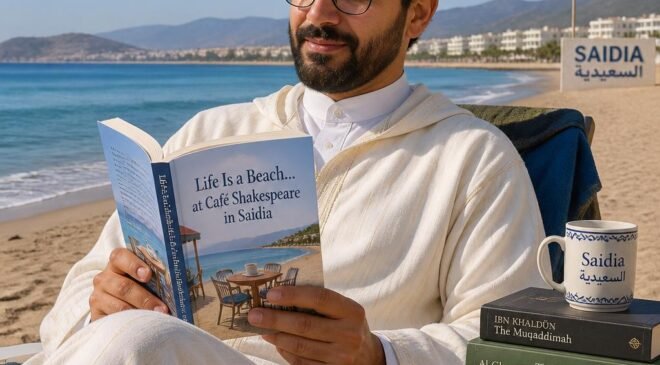
Morocco is supposed to be a nation that reads, at least judging from the prominence of the annual book festival in Rabat. Today, it seems that most people are unable to read books—and not only in Morocco—because their brains and attention spans have rotted due to addiction to their smartphones in general, and scrolling and short videos in particular. Here in Saidia, local language-and-literacy activists are trying to reverse that trend by inviting people to their new no-wifi café bookstore, Café Shakespeare.
Civilizational States, Multipolar World
Morocco finds itself among several nations whose identification with unique and ancient cultures set them apart from “McWorld.” These nations demand the right to govern themselves in their own way, not necessarily in line with US-imperial notions of Zio-oligarch fake democracy, worship of sexual minorities, and the eradication of ancient religious and cultural traditions and institutions.
China is recovering its civilizational heritage after its “century of humiliation” followed by decades under a fanatical modernizing Western ideology, communism. Following its de facto return to pragmatic Confucianism in the 1990s, China’s per capita income has increased from under US $50 per year to today’s over $6,000 per year.
Russia, too, is recovering from decades of communist genocide, followed by a horrific US-imposed 1990s collapse, and rediscovering its Eastern Christian identity. Likewise, Iran’s 1979 Islamic Revolution helped it recover from a long period of imperial exploitation and “Westoxication” and begin to reassert itself on the world stage—to the point that today it is playing a heroic role in the defense of the Palestinian and Lebanese people from Zionist genocide, and has just defeated the Israeli-occupied United States in what will one day be viewed as the most important war of the 21stcentury.
Morocco never suffered under communism like Russia and China, and its anti-colonial revolution was gentler and more tradition-oriented than Iran’s. But like those countries, Morocco is an important civilizational state in the emerging multipolar world. And like those countries, Morocco insists on the right to choose the path of continuity—in this case, of 1200 years of monarchical dynasties ruling societies whose cohesion has been rooted in the local interpretation of Islam.
That continuity offers Morocco an opportunity to build on a pre-existing tradition. The Moroccan civilizational state can soar, insha’allah, to higher states and manifestations of its unique civilization.
Mawlid an-Nabi, like Moroccan-style Islam and dynastic rule, has been here for many centuries. Neither Saudi Salafis, nor communist materialist radicals, nor fanatics for so-called democracy or gender equality or LGBTQ, nor the puppetmasters of whatever forthcoming fad may come oozing out of our phones next, is likely to take it away any time soon.