


Laith Marouf reports from Madrid’s ‘Casa Arabe’ with anti-imperialist organizer Iker Suarez to investigate the Spanish Kingdom’s multicultural facade – built via the colonial weaponization of Iberia’s Arab-Islamic civilizational heritage to launder it’s historic and ongoing role in imperial genocide. The pair also discuss the migrant genocide taking place on the frontiers of Fortress Europe in connection to the Gaza extermination camp, and the need for an anti-colonial reckoning within western “progressive” movements.
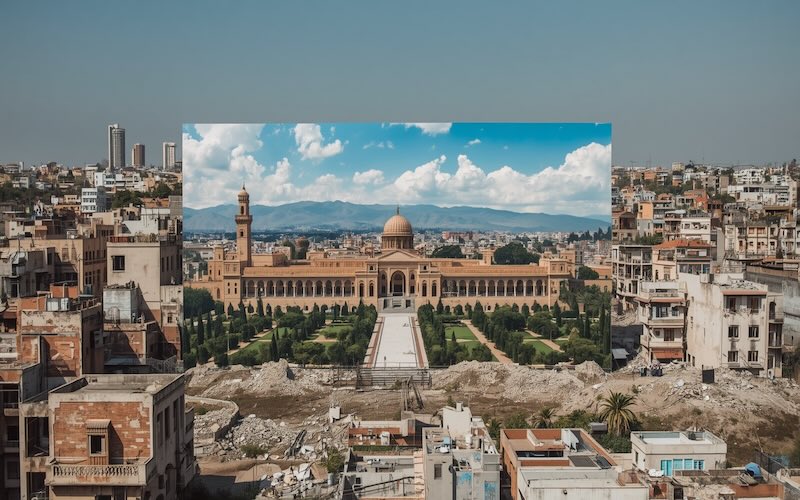
About the beginnings of this building, why was it built and when was it built? So what we see here is a building that was built in the 1870s and that follows what is called the Neo-Mudejar style. Neo-Mudejar style takes the style of the Mudejars, which are the Muslims that stayed in the Christian part after the crusade against Al-Andalus, right? And so it was a style that was used by Spanish and also then European elites to exoticize, right? To orientalize sort of these things. This is built in the 1870s and it’s a way of thinking that this a uniquely Spanish style because it combines the more Christian, if you will, modes of architecture with the more Muslim, Andalusian sort of style. And the reason I wanted to show you this is because it’s built quite at the same time as the Columbus statue that we just saw.
And so in this thing we see, in this sort of comparison, we see the two poles of, if you will, the Spanish ideological spectrum, the Spanish identity. On the one hand, the very unrepentant: “We are the Columbus-led settlers that wiped out entire nations.” On the other one, the one that romanticizes its own sort of relation to its colonial past, right? When we know, obviously, that The expulsion of Muslim people from the Iberian Peninsula was a violent process that ultimately ethnically cleansed Spain to make it what it is or what it has been. And today it continues to ethnically cleanse Muslims insofar as it deports them and kills them. So I think it’s just important to have this nuance between the two posts.
It’s not just unrepentant colonialism. It’s a form of, if you will, imperial multiculturalism that takes up some of these symbolic cultural presentations of the Muslim world, of the Arab world, of the Andalusian world to kind of prop up its own position as a multicultural, liberal, enlightened sort of situation.
You know, when you said 1870s, we all know how much that era was Orientalist, everybody dressing up in clothes that are from the region, doing the seances and everybody loving Jibran Khalil Jibran from Lebanon and the Freemasons and all of these things that were trying to extract all culture from the Arabic world and forgetting all the colonial eras that led to that. How do we connect this with what the Spanish government is using this in its foreign policy? How is it using that in comparison to its activities around the world that are still very anti-Arab and anti-Muslim?
Well, it’s a way to launder their own image and to feign proximity, cultural proximity to these Mediterranean values, if you will, or these values that were shared n the convivencia period, in the coexistence, said to be between the three cultures, right? And so in a way, it’s just a marketing operation, right? And this place specifically has good cultural programming that brings some of Arab culture to Spaniards. And in that sense, it’s positive. But also as part of the government initiative, it’s a way to, once again, prop itself up as enlightened and multicultural.
And what we see with this is not just this. It’s that there’s a whole set of institutions. You’ve probably seen this also in Andalusia, but you also see it a lot in the two enclaves that Spain still occupies in the north of Morocco, in the Rif, Ceuta and Melilla, which are still occupied on African soil.
This multiculturalism serves as an alibi for the neocolonial system, for a system that continues to extract from the South while pretending to be friendly to these cultures or to these formations, et cetera, et cetera. And I don’t know if you know a little bit about Ceuta and Melilla. Maybe if you want, I can talk a little bit about that…
Ceuta and Melilla, they’re in the north of Morocco, two small enclaves. I wrote a book about Melilla, one of them. Twenty-five percent of the territory there is military-owned? And it’s one of the only two land borders of Europe with Africa. So you have the big fences.
The fences that you usually see about the United States and all of these things, the only two such fences dividing the African continent from Europe are there. And so it’s a place where many massacres have happened of people trying to cross the fences and the police shooting them.
Under the progressive government, under all governments, this has happened. And so it’s a very sort of intense site of… And it ties back to the concept of the migrant genocide that we were discussing, which ultimately means we will kill these people from the South.
We will not let them enter on the pain of death, to keep our wealth, to keep our social peace and at home, et cetera, et cetera.
That’s the wealth that we extracted already from the lands of those migrants. Exactly. For centuries, right?
And so I think the connection, interesting connection between these dynamics of the border and border deaths and Gaza is a very literal one, right? First, I mean, obviously they use similar technologies, drones, et cetera, et cetera. But also there’s a lot of Gazans, Palestinians, that have died in the Mediterranean trying to cross the border to Europe. So there’s a literal continuity of the genocidal logic between people that are in Gaza and die under the Zionist bombs, right? And people that don’t die under the European bombs but die under the European neglect at sea, right?
And there’s been funerals in Gaza held for these people when they died, remembering them, because Europe had killed them. So it’s very close. I think that’s the key connection, right? Whether some people try to make Palestine an exception, right? And in many ways it is. But also you see continuities with the rest of the Arab world and the Arab nation and the South in general. And so these sites where you have this particularly sort of intense brand of multiculturalism, right? Of the three cultures, of the four cultures where “we are incredibly open to all of the cultures,” right? It’s funny because they also include as one of the cultures the Roma. They attempted to do a genocide against the Roma in Spain, right? In these sites of very intense multiculturalism are also the sites where these deadly logics also materialize the most…
Watch the video for the full conversation.