

This concise comment on a review of Flaig’s A World History of Slavery is such a good introduction to the topic that it deserves this stand-alone post. Also see John Andrew Morrow discussing his book Islam and Slavery. -ABaB
A Rebuttal of Zionist Propaganda About Islam and Slavery
There is no ‘challenge’ to any serious student of Islamic history in (the reviewer’s) assertion that Islam is by its nature a religion of conquest and forced conversion, inclined by nature to create slave societies…
Use the time span extending from the earliest days of Islam until the last endeavor of Muslims to expand Islamic territory in Europe during the late 18th century (when America was a fledgling nation). Within that time period of more than one millennium, the number of forced conversions to Islam won’t even register as a fraction of one percent. Feel free to present the evidence if you believe otherwise.
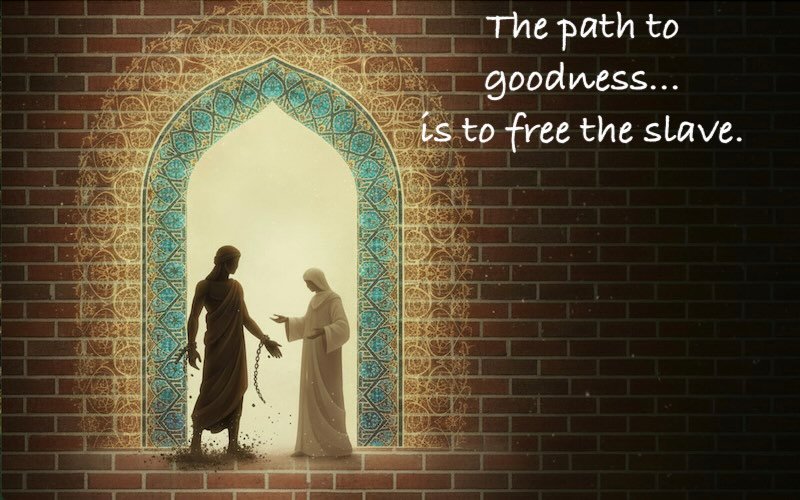
The right of conquest was the order of the day for thousands of years until the formation of the United Nations, and even as we speak, the very nation hosting the U.N. doesn’t seem much interested in abandoning it. In any case, Islamic polities were hardly unique insofar as the phenomenon of conquest is concerned. Moreover, to say the motive of Islam was ‘to create slave societies’ bespeaks ignorance. The Qur’an is the only religious text that explicitly extols the freeing of slaves, describing it as a means of expiating of sin. No other religious text comes close and a smattering of quotes from a handful of medieval Christians hardly constitutes evidence of a widespread worldview more humanitarian than that of Islam’s.
Renowned scholar of Islamic Studies, Bernard Lewis (whom the author quotes) writes:
Though slavery was maintained, the Islamic dispensation enormously improved the position of the Arabian slave, who was now no longer merely a chattel but was also a human being with a certain religious and hence a social status and with certain quasi-legal rights. The early caliphs who ruled the Islamic community after the death of the Prophet also introduced some further reforms of a humanitarian tendency. […]
He [the slave] was, however, distinctly better off, in the matter of rights, than a Greek or Roman slave, since Islamic jurists, and not only philosophers and moralists, took account of humanitarian considerations. They laid down, for example, that a master must give his slave medical attention when required, must give him adequate upkeep, and must support him in his old age. If a master defaulted on these and other obligations to his slave, the qadi could compel him to fulfill them or else either to sell or to emancipate the slave. The master was forbidden to overwork his slave, and if he did so to the point of cruelty, he was liable to a penalty which was, however, discretionary and not prescribed by law. A slave could enter into a contract to earn his freedom, in which case his master had no obligation to pay for his upkeep. While in theory the slave could not own property, he could be granted certain rights of ownership for which he paid a fixed sum to his master.
Slavery was a normative phenomenon for centuries — just the way so many things were accomplished. Its prevalence in any given society correlated to economic strength therein, which is how we can account for the large numbers of slaves once present in Islamic societies. Quite simply, they were much wealthier than their contemporaneous counterparts. As Europe strengthened in the late Middle Ages, its own slave trade experienced greater success — not at scale, but successful enough for its time.
(Another detail… Muslims themselves did not castrate male slaves. That job was farmed out to Christians, who ran very lucrative castration mills in Egypt and Italy. No, it doesn’t diminish the role of Muslims in the slave trade, but it helps to get these facts straight.)
As Walker correctly suggests, it’s a distortion of the historical record to posit that chattel slavery ended in the west due solely to the efforts of altruistic abolitionists and Flaig is clearly polemical in depicting scholarship that justifiably draws attention to material motives as ‘Marxoid’.
By the early 1900s, British sugar plantations in the Caribbean were facing intense competition from non-British colonies and alternative sources like beet sugar. The old mercantilist system (which protected British colonial sugar) was becoming a burden on the British economy. The Industrial Revolution shifted Europe’s economic focus from agricultural slave labor to industrial wage labor. Adam Smith and other economists argued that free workers, motivated by wages, were far more efficient and productive than enslaved workers who had to be coerced and maintained. Industrializing nations needed raw materials (like cotton and palm oil) and global consumers for their manufactured goods. A global population of enslaved people who could not earn wages made for a terrible consumer market.
We also shouldn’t understate the impact of the Haitian Revolution in the late 19th century, an uprising that sent shockwaves throughout Europe. Britain’s own abolition of the slave trade came soon after this, and its final abolition of slavery followed a series of colonial slave rebellions in the early 1800s, proving that maintaining slavery required constant, expensive military occupation and was, as such, unsustainable.
Additionally, Britain wanted to ensure its economic rivals could not benefit from cheap slave labor while British colonies were forced to adapt to free labor, which is how we should frame its own anti-slavery ‘crusade’, one fought more for its own material interests than any altruistic motive.
The Muslim world of the 19th and 20th centuries was slower to industrialize than was Europe, though the Ottomans did institute reforms against slavery by the mid-19th century. FWIW, their initial aversion to the printing press was attributable to the respect accorded scribes that had been cultivated for centuries in Turkish society. Printing Ottoman script also proved challenging and was not as aesthetically pleasing.
Anyhow, we’ve now replaced the chattel variety with wage and debt slavery. Indeed, liberty is superior, but the extent to which we actually enjoy it in an ‘advanced’ society so burdened by these new iterations of servitude is a fair question, one at which Walker hints in seeking a clearer definition of slavery.
Personally, I find contemporary appeals to this aspect of Muslim history play into the hands of Zionists, who are the most prolific promulgators of anti-Islam propaganda on the planet. For them, all of this is a timely deflection, a concerted effort to have us travel backward to an irretrievable past in order to justify their current dehumanization and slaughter of over five million Muslims since 9/11.
The Open Doors Foundation, the Christian Zionist organization most responsible for propagating the myth that Islam necessitates slavery, uses examples like Libya in order to broad brush the entire Muslim world, the vast majority of whom have moved on from the institution of slavery and assented to language proscribing it in the U.N. Charter.
The threat of slavery from the contemporary Muslim world is an illusion concocted for the purpose of advancing that clash of civilizations between the west and Muslim lands which best serves Israel and its genocidal myrmidons.
—