

NAOKI YAMAMOTO, The Way of Futuwwa
AUG 6
This is the introduction to a lecture I will be giving in Istanbul next week.
—
“What Do You See?”
When I was training in the Japanese tea ceremony, my tea master once pointed to a hanging scroll in the tea room and asked me,
“What do you feel when you look at this scroll?”
To be honest, I was never particularly good at reading the old styles of calligraphy used on such scrolls. I stood there in silence for a while, trying to decipher the characters.
My master then began to speak.
“I am not asking you about the meaning of the words written on this scroll.”
Instead, she began to tell me about the monk who had written it.
“When he was young, he was renowned for the power of his brushstrokes. His writing possessed remarkable strength and vitality. But this scroll was written in his old age. By then, the physical power that had once animated his hand had largely disappeared. If you look carefully, the final characters are thin and almost fragile. Yet he chose to leave this work behind.
“He did so because this is not merely his own story. It is the destiny every human being must eventually face. No matter how strong a person may be, old age will ultimately strip away that strength. Everything in this world passes away. To accept that reality with dignity is itself part of what it means to be human.”
She paused for a moment before continuing.
“And perhaps this may not be a lesson unique to Buddhism. Surely other religious traditions have something similar to say. If someone from another faith were standing here instead, what would they see in this scroll?”
My master rarely spoke about religion. In Japan, this is hardly unusual. For most Japanese people, religious belief remains a deeply private matter. Yet on that day I had the distinct feeling—though I could not fully explain why—that she had quietly entrusted me with a lifelong question.
As a Muslim, what do I see in this scroll?
That question became even more significant because my master often gave me another piece of advice.
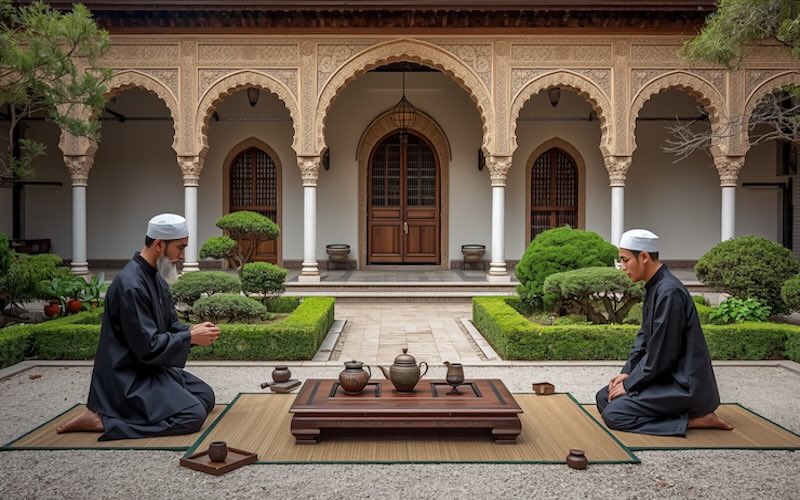
“If one day you leave Japan and perform the tea ceremony abroad, it will never be enough simply to reproduce what you learned in this tea room. That would not be a living tea ceremony. It would merely be the display of an artifact, preserved inside the comfortable bubble of your own culture.
“If you practice tea in Türkiye, learn to explain it in ways that allow Turkish guests to feel that it also speaks to them. Study Turkish intellectual and spiritual traditions. If there are elements of Turkish art that can enrich your practice, embrace them.
“If you perform tea in the United Kingdom, ask yourself what expresses the spirit of that society. If you practice in a Muslim community, ask what the Islamic artistic tradition might teach you. Above all, ask yourself who you are. That is what culture truly is.”
Looking back, I have come to realize that she was teaching me something far deeper than the etiquette of tea.
To inherit a tradition is never simply to preserve it unchanged. Tradition survives only through continual renewal, as the self encounters the other and, through that encounter, comes to understand itself anew.
A living tradition therefore does not merely preserve forms; it also cultivates the imagination to see meaning where others see only difference.
Years later, I realized that my master’s question was not really about Buddhism, nor even about tea. It was about whether one possesses the imagination to encounter another tradition without reducing it to an object of judgment.
It is precisely here, I believe, that contemporary Muslims face one of our greatest intellectual challenges.
“Do Not Wear the Clothes of the Kuffār”
Yet I remain deeply skeptical that we, as Muslims, are adequately prepared when confronted with my master’s question:
What do you see? What do you feel?
When Muslims encounter Japanese culture—or East Asian cultures more broadly—the question most commonly asked is not philosophical or civilizational, but:
“Is this permissible in Islam?”
Too often we approach another civilization primarily through a binary framework of permissible and impermissible, Islamic and non-Islamic. The result is that we become preoccupied with guarding ourselves against potential threats to our faith instead of asking what intellectual, artistic, or spiritual insights another tradition might reveal.
I remember one particular Eid when I attended the mosque in Japan wearing a kimono. A Muslim man, with complete sincerity and good intentions, approached me and said,
“You should not come to the mosque wearing the clothing of the kuffār. If you dress like them, you will eventually become like them.”
I never doubted the sincerity of his advice. What surprised me came years later, when I began to study the history of the kimono itself.
Beneath a kimono, one traditionally wears an undergarment known as a juban (襦袢). According to the standard etymology, the word derives from the Portuguese gibão, which in turn ultimately comes from the Arabic jubbah. During the sixteenth century, Portuguese merchants introduced the term and the garment gibão to Japan. Over time, however, the word acquired a new meaning in Japanese, eventually referring to the under-robe still worn beneath the kimono today.
The history of words often preserves encounters long forgotten by those who inherit them.
The garment that was dismissed in a Japanese mosque as “the clothing of the kuffār” quietly preserves one of the few surviving linguistic traces of cultural exchange between Japan and the Islamicate world. If a Muslim can see in the kimono nothing more than “the clothing of the kuffār,” while overlooking the historical traces of exchange embedded within it, then the problem is not merely one of self-assured judgment. It reflects a deeper historical forgetfulness.
This episode illustrates a problem that extends far beyond a single misunderstanding. The difficulty is not simply the product of one ideological current within contemporary Islam. Rather, it reflects something much deeper: a collective amnesia regarding the history of Islamic civilization itself.
Islamic civilization has never been a self-contained world sealed off from others. Throughout its history, it expanded through encounters, translations, borrowings, adaptations, and creative appropriations across linguistic, cultural, and religious boundaries. It did not flourish despite these encounters, but because of them. Moreover, its cultural influence often extended far beyond the regions with which it maintained direct political or religious contact, leaving traces even in places that appear, at first glance, to have stood outside the historical geography of Islam.
And perhaps even more troubling is what this amnesia has done to our intellectual confidence.
Many Muslims no longer believe that they can approach another civilization as interpreters. Instead, we reduce ourselves to superficial critics whose task is merely to classify cultural phenomena into neat binary categories. In doing so, we forget that a living tradition does not simply preserve inherited answers; it also cultivates the imagination necessary to ask richer questions.
Recovering that imagination is, I believe, one of the central intellectual tasks facing Muslims today.
—
In this lecture, I would therefore like to share with you what is perhaps an extraordinarily presumptuous—and almost certainly foolish—attempt: to participate, however modestly, in the long history of Islamic art by attempting to interpret Japanese culture from within its tradition. Yet I also believe that this aspiration is, paradoxically, deeply faithful to tradition itself. For tradition is not sustained by passive preservation alone. It endures through those who dare to receive it, question it, and carry it into conversations with worlds that earlier generations could scarcely have imagined. If my reflections succeed in doing even a small part of that, then they belong not outside the tradition, but within its continuing life.