

Ceuta and the Long Memory of Purity: You are a virus born to die Inside the Line
By Mo Hamdouni, Moroccan Epistemologies
In everyday usage, ghorba names strangeness and the fact of leaving one’s land under obligation in order to reach another. One hears exile in it immediately, and stops there. But exile presupposes a whole land left behind, a place one might have chosen not to leave; ghorba begins before departure and does not end on arrival. The word is older than migration, and wider than it.
The root says as much before the poets do. From gh-r-b come gharb, the west, ghurūb, the setting of the sun, and gharīb, the stranger; the west is the place where the sun disappears, and the stranger is the one who goes toward that place. The Maghrib is the land of the sunset, which means that those who live there carry disappearance as an address in the very name of their country. To swim toward Europe, for them, is to go west, that is, to set. The language had said everything; it took bodies in the water for anyone to hear it.
Modern Arabic poetry knew this before the social sciences did. The Mahjar poets wrote from a double impossibility: the destroyed homeland on one side, exile on the other, and these two conditions do not add up, they multiply. What their language records is not the pain of leaving but the discovery that return would have repaired nothing, since the place of origin was already lost at the moment one inhabited it. The crisis is not geographical; geography is only its staging.
Maghrebi orality never needed a literary movement to say it. Tgherebt f bladat nass, lghorba morra (I lived strangeness in the countries of people, ghorba is bitter), in one of its many rural variants. One must hear nass, people, and not the foreigner or the West: one is not a stranger in a foreign country, one is a stranger in the country of people, that is, where bonds exist and none of them hold you. The bitterness here is not a feeling but a taste, a modification of the body, something that stays in the mouth after the fact has passed.
The term is therefore a portmanteau, and must be treated as one. It holds together strangeness, complete unfamiliarity (the kind where nothing answers any more when called by its name), and the social exterior that kills. This last element is what translations most often erase: ghorba also names an alterity that makes one disappear, a position outside the group where one gradually ceases to exist for others. Once social exteriority is lethal, ghorba is not an affect but an exposure, in the sense in which one says of a body that it is exposed.
The word was available before July 2026. It was the events at Sebta that made it necessary.
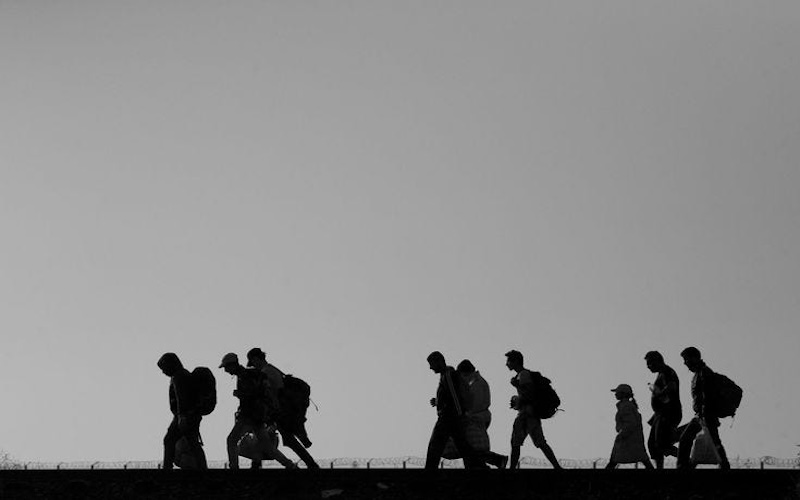
Within a few days, tens of thousands of people, fifty thousand, sixty thousand depending on the count, entered the water on the Fnideq side. Many were sixteen or seventeen. At least fifty-seven did not cross; the sea kept them. Then, almost at once, the movement reversed: finding neither bread nor shelter on the other side, many went back of their own accord, along the same breakwater, the salt still on their skin. That voluntary return is the most eloquent fact of the week, and the least commented upon: it establishes that the crossing was not a wager on Europe.
There is a conventional way of reading what took place there: bare life, the human whom sovereignty abandons to his own exposure, the homo sacer. The reading remains correct. It becomes insufficient the moment one looks at the language used to describe those bodies: the assault, the wave, the surge, the invasion. That lexicon is neither juridical nor military, it is epidemiological, and this displacement changes everything. The sovereign ban has migrated from the register of law to that of health, and the migration grants it an unexpected privilege: one no longer needs to declare the exception if one invokes the body.
Call this figure the homo virus. Where the homo sacer is abandoned because he stands outside the law, the homo virus is contained because he stands outside the body; he is not judged, he is held back, and holding back requires no procedure. It is no longer a life that sovereignty relinquishes, but a load that the social organism must repel, which presupposes that there is an organism, a membrane, an inside that thinks itself healthy. The border then ceases to be a line and becomes an immune wall, and the violence exercised there justifies itself not by law but by hygiene.
The vocabulary, moreover, is not a metaphor that politics borrows from medicine. The reverse is true. Quarantine appears in the late fourteenth century in the Adriatic ports, at Ragusa and then Venice, as a device applied to ships coming from contaminated places; the lazaretto is an island, the cordon sanitaire a line drawn by physicians before it was drawn by states. What Sebta applies to swimmers is the original device, transferred from cargo to bodies. There was no metaphorical drift; there was a return to the source.
What remains is the seam, and it decides everything. Ghorba is spoken in the first person: it is the name given by those who live it, in their proverbs and in their songs. Homo virus is always spoken in the third: it is a designation that comes from outside, pronounced by those who have never had to carry it. What happened at Sebta is neither one taken separately, but their meeting: a lived condition presenting itself at the counter and receiving, by way of answer, a sanitary classification.
For that man does not begin his ghorba in the water. He is born in a country that colonization stripped and that corruption and neoliberal reality continue to empty, and he lives there what Moroccan speech calls hogra: a systemic, daily humiliation, administered by his own and by the nearest power. This is the first ghorba, the one that has no border because it is interior, and that never declares itself since it is the climate. There are therefore two sterilizing agents and not one, and the first speaks his language, knows his name, and administers his native quarantine long before Europe has to sort him.
The choice on offer, then, is not between staying and leaving, but between two ghorbas. That of confinement, slow, which kills by attrition among one’s own, and that of the crossing, which requires becoming entirely naked and, on top of that, pathologized in order to have a chance at surviving. To swim toward Sebta is to trade a death by hogra for a death by hostility; this is not hope, it is arithmetic. Colonial logic holds here in a single sentence: I draw the border and I ask you to die inside it.
This wall has a memory, and that is what makes it properly immune. An immune system is recognized by this: it responds faster to what it has already encountered. Ceuta in 2021, Melilla in 2022, and this time a French border reinforced in under twenty-four hours, a thousand kilometres from the breakwater. The first exposure goes back far, at least to the blood purity statutes promulgated at Toledo in 1449, four decades before the fall of Granada: certificates already, suspect lineages already, already a social body purging itself of what it declares impure. The inquisition has not disappeared, it has been updated: visas, biometrics, readmission agreements. The gesture is the same; only the laboratory has changed.
The benefit must then be named, without which the analysis would remain an accusation. The state does not fear contamination, it draws a dividend from it: every focus of infection maintained at the wall justifies a budget, an agency, a show of firmness, an electoral cycle. To immunize, in Latin, is to exempt oneself from the munus, that shared charge which makes community; immunity is literally an exemption from obligation. This is why the breakwater served in both directions within a few days: the membrane does not prove its competence by closing, it proves it by letting them go back.
Let us take this lexicon, then, and turn it against itself, knowing what we are doing, since this vocabulary served against Jews and against Muslims before it served against the young men of Fnideq, and will serve again. If one accepts for a moment to call contamination whatever crosses an enclosure, then one must imagine Moses and the first monotheism as an Egyptian infection, Christianity as a Roman epidemic, and human civilization in its entirety as a series of successful contaminations between those who were in ghorba and the order that sought only to reproduce itself. What the order names contamination is, each time, the retrospective name of what brought it into being; every instituted form began as the disease of a previous form. The pathogen is a position and not a person: viral is the name given to whoever carries an outside into an inside that believes itself closed.
Ghorba does not ask for papers. It asks for a world in which being present would be enough to belong, and that world is missing on both sides of the stone, among those who sort as much as among those who humiliate. As long as it is missing, the order will go on calling infection the circulation of those it made strangers itself; and history, which is made of nothing but successful contaminations, will go on proving quarantines wrong, long after the bodies have been sent back through the same narrow passage, westward, where the sun sets.